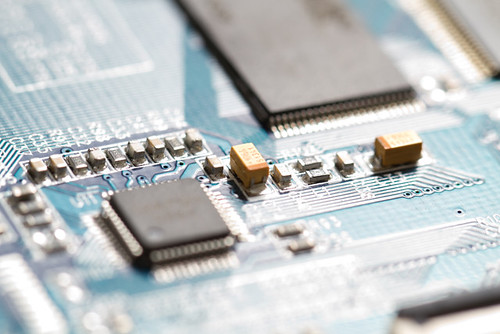
Circuit Board by Fisherss Zhang
It seems that Spring is the time the of year for technological mayhem to come down on me. Always. I don't know if it is the tricksy hand of Fate or something less cosmic. The laptop being the sole canvass on which I write my novels, this is always a big deal.
2012: computer virus - vanquished with the proper dosage of anti-malware software.
2011: laptop fails to recognize power cord - BestBuy (grr!) sends laptop to Dell to fix.
2010: Jillian falls down the marble staircase at work, is fine but laptop is injured in the most expensive (warranty-won't-cover-it) way; the screen is spider-cracked. Costs hundreds to repair.
2009: Old (5 year old) laptop acquires virus and Jillian buys the new Dell.
This year, aside from the typical wear-and-tear, unsightly scratched keys and dusty screen, the 4 year old Dell is healthy. The casualties this year are two of the secondary gadgets that have become important to my creative life. 1.) My little green iPod nano (6th generation) died a sudden, unexplicable death after a year and a half of musical life. It simply died in its sleep. Baffling because I purchased the thing to replace my 7 year old iPod Classic, which for some reason STILL WORKS. 2.) The 4GB flash drive that I use to store the scanned files of my writings from the nascent childhood years through high school decided that it had no will to live, either. Plugged into the computer, the laptop doesn't acknowledge its existence. Neither does roommate's computer.
These, in comparison to the laptop woes of yesteryear, are more inconveniences than crises. The iPod can be repaired (for a fee) or replaced. My music is safe. The only thing I can't do is walk around with my creative mixes and transport myself into those inner worlds. (The Olde iPodde only works from one earbud and has to be plugged in all the time.) Yes... there is that thing called silence I've discovered recently. Nothing tickles the anxiety demons like listening to a lot of loud epic music (ahem, Two Steps from Hell). Walking in silence allows me to take in the sounds of birds, of people talking, of the wind in the trees, thunder, planes, etc. An internal, world-building brainstorm takes shape in a quiet(er) mind... on its own, without any help from soundtracks or symphonies. Nothing clears the mind like quiet. Nothing.
The flashdrive is probably the bigger problem. The day I discovered the 4GB's death, I spent way too much time trying to find solutions via Google. The verdict is that the thing is dead, dead, dead. Some tech-savvy people had suggestions for taking the drive apart to see if the elements in it were broken, and if they were, solder them back in place. Even if I could take the thing apart, that seemed out of my range of skills. Another idea: send the drive into a data recovery service for a couple hundred dollars and receive the files back on a disc. Hm. Not today.
The bottom line on the flash drive problem is that this form of data storage is getting cheaper to obtain, therefore it's wearing out faster. I had no idea about that. All I cared about was that the flash drive could hold everything from my 1,000 page high school journals and much more and STILL fit in my hand. For years, the flash drive has been the convenient alternative to the compact disc. And now... learning that I should have had back-ups to these back-ups is news to me... that perhaps I was foolish to be scanning those files onto a flash drive instead of the harddrive in the first place, because all of my careful work is essentially gone. All those writings, musings, prayers and projects - not to mention hours upon hours of scanning it all page by page - gone. Almost.
Upset as I was, I didn't shout: "Cry havoc! And unleash the dogs of war!" or "My kingdom for a flashdrive!" I didn't beat my breast and roll in the ashes. I took a hard look at these things I'd held so precious for so many years, scanned to PDFs and finally shredded. Why did I shred those things? Those papers and letters and journal entries and poems? These same things that took up most of the space in my backpack in high school? I shredded them to make space for other things on the shelf, to be more organized. I scanned them as an act of preservation, to remind myself where I started in this writing life. But... I did not scan them to tell me where I was going. In all honesty, I hadn't touched the 4GB in months. If not for the residual pile of papers I wanted to scan, I would have forgotten it was there.
All of this has me thinking about our reliance on technology... from e-readers to iPads to data clouds. Nothing lasts forever. I remember that my parents decided to assemble items for a time capsule around the time of the millennium. I had a brilliant idea: record audio tapes (the favorite creative medium of my sister and me) of the four of us to carry messages into the future. No, my dad said, it won't work; the batteries and the magnets will have worn out by then. Or the technology will be so changed no one will know what an audio cassette is when they pluck it out of the box, just a hunk of plastic with a not-so magnetized ribbon and some holes.
In this world, technology is obsolete the moment you buy it. In a few years, when your MP3 player fails or your laptop bites the dust or your phone "needs" new apps, you'll wind up buying a new one, the next bigger-and-better thing. Nothing we make will ever be completely permanent or backed up. What about the pyramids, you ask? Well, even those can crumble into dust. Nineveh, anyone? Whole cities and civilizations have been lost to the devestation of time. Whole libraries have burned. A number of Shakespeare's plays were lost. This is not going to change simply because we have "better" technology - portable data drives and that nebulous thing called a data cloud. These things break. Data clouds, as I understand it, are expensive to maintain. What about hacking? And server glitches? What happens if everybody saves everything to these clouds - pictures, videos, journals, recipes, stock market numbers - and the clouds keep growing? Can the clouds hold it all? Or will they burst and come raining down? (And... there is an idea for a sci-fi story.)
This isn't a campaign for writing everything on paper and throwing one's laptop or computer tablet out the window. I'm all for technology - old and new. This is why I get excited about typewriters and calligraphy, old stand-by technologies that may be out of style in some spheres, but are definitely alive. Perhaps I've read too much dystopian fiction lately (i.e.
The Stand by Stephen King and
The Passage by Justin Cronin), but I can't help finding the thought of typewriters and pens and paper comforting... something to fall back on if or when the lights go out. Ah, technology - the tools change but the goal is the same: create something new.
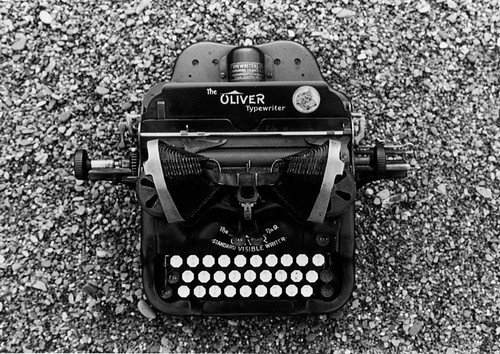
Old Typewriter by Peter Gray
If time passes and I learn that the files on my flash drive are irretrievable, it will be a sad day indeed. But... I have what I need to write forward. If my iPod cannot be revived, I'll purchase a new one. Not all is lost. What's important cannot be down- or uploaded, saved to multiple devices, locked in a safe. It's inside: that passion to create something new. And sometimes, frankly, we have to make room for those new things.
And I'm okay with that. Are you?