It has been roughly 13 months since I posted here, also roughly longer than that since I withdrew myself from Twitter and stopped visiting other writing blogs. I thought no one would notice, and no one did... until this week. Kind anonymous soul who noticed my silence, thank you for getting my attention! Bok choy roses - what a great image to end on.
Where in blazes have I been? Writing and rewriting my novel. The same novel? Dude! Yes, the same novel. But as I'm trying to deep-delve into this brand new draft, it has taken up a lot of my creative energy... simply because I'm in new territory and am just now starting to see where it is going. Also, working a full-time job takes its toll.
Why withdraw? Our readership has never been massive, and I am increasingly overwhelmed by the chaos of the internet. It was not the same world it was when Michelle came to me with the idea for Daedalus in 2008. Twitter most certainly didn't exist as the ubiquitous soapbox-opera that it is today. Every time I happen to visit a blog, or advice on blogging, there is always some push to be making a lot of noise, draw a lot of attention, be "stellar", market yourself, etc, when I all I want to do is write and have thoughtful interactions with other writers. Twitter doesn't work for me, simply because I can't keep up with it. There are too many voices and only so little time.
Blogging is a lot of work. But it still appeals to me as a project completely within my control. Others might argue that pursuing writing jobs at publications is a better career choice, but that isn't my goal. I want to connect with people, but not because I want to sell them something. That was the idea behind Daedalus Notes. Soon, I hope to have a fresh, new blog to begin again.
Feel free to peruse our old posts and ideas, and - please, please, please - let us know your thoughts by leaving comments. There will be updates on my new project in the very near future. Take care!
Tuesday, September 15, 2015


Tuesday, August 26, 2014
Bok Choy Roses
The last time I cooked with bok choy, I realized the cut ends look like an arrangement of green roses or hellebores. It simply amazes me how nature surprises us with its simple, unexpected beauty.

Creative Life in Progress
Summer is on the wane. You can hear it in the crickets and the cicadas, the crows and the tall, ripening corn. The days have been getting shorter since June, and blissfully cooler mornings are returning to give us brief respite from the notorious August heat. As time goes on, super moons come and go, I've been working as usual on writing and life in general. Nothing terribly earth-shattering or noteworthy, just life. And that's okay.
Sometimes, I realize, I don't run and hide from this little blog so much as drift away from it, enjoying a bit of insular creativity. I've not been writing in a vacuum per se - no one can really do that. This summer has been an exercise in Not Caring (so much) What the World Thinks: untangling myself from the habits of reading tweets and visiting beloved blogs, avoiding online "advice", and making my own way on this creative path. For a person who gets easily confuddled and stressed out the more "voices" are speaking, this was the sanest choice.
One thing I re-learned this summer - which happens to be my first summer in my solo apartment - is how creativity isn't just about working on a novel, coming to the journal on a daily basis, or even strictly for whatever art may be your heart-work. Creativity is a way of living, of solving problems, of stretching little skills. When you're a writer working a not-so-lucrative job and move into a small solo apartment, you find ways of making up for things you need that roommates previously had (i.e. a juicer). It's also nice to discover what things you don't need and won't miss. Life suddenly becomes flexible, manageable, and fun.
I didn't have a spice rack when I began to stock my tiny kitchen. I love to cook so I had a fair number of little jars of thyme, nutmeg, cloves & cinnamon. As I get older, I seriously questioned the logic of buying something brand new just to hold a bunch of spices, although, frequenting Michael's and other crafty places it was darned tempting to fork over my money for something that was simple and cute and maybe made out of chicken wire. I stopped, had a think and realized I had a CD rack sitting idly by, pining away without a purpose. An idea was born. Probably not the first time such an innovation was made, but sheer brilliance where I was concerned. After all, I use iTunes like I use air and CDs have long come to be nothing more than ultimate wasters of space. These were sequestered into storage and out of my hair. Then, I cut up pieces of binder cardboard, covered them with craft paper and voila:

Many innovations have followed. That old wooden pizza paddle? A cutting board. The tea kettle that is missing a handle? Utensil holder. No lid for a sauce pan? Use that little skillet. What about this useless (except for Christmas) pudding tin? Look: it's a reservoir for all my chargers. What about these pretty but broken tea cups and saucers? Soap dishes and make-up holders. The vases that seem to multiply every time I visit my elderly neighbor? Holders for pencils, silverware. That chipped tea pot (I have two nicer-looking ones)? Planter. Paella pan? Tray for the living room ottoman. Old tea tins? Again, pens and pencils, loose change. What can I use for a rolling pin? A wine bottle. A juicer? The top of a tea pot or your fist. Fruit bowl? That bundt pan I use twice a year. When you think about it, the possibilities are endless.
I have to admit that I was in such a repurposing frenzy that I almost, almost used the back of my old (cheap, Target, fiberboard) book case to make a room divider. I waited ten minutes, the scales fell from my eyes, and into the dumpster it went.
Another big innovation, which raises eyebrows in some circles, was my headboard. It's one of those bookshelf headboards - great if you like reading in bed but not if you happen to have a wily cat who likes to explore and drop things on you as you're trying to sleep. Besides, it rattled. And it looked funny against the windows. And I don't read in bed all that much anyway. One day I unscrewed it from the bed frame and hauled it into the closet to serve as a dresser, which I desperately needed.
I have no pictures of it because my closet is rather unslightly. I've decided that the shelves don't really work to organize piles of tights and t-shirts, so plans are simmering in my brain to find tote-boxes or baskets that fit the headboard's particular dimensions. I also want very badly to paint it a softer color. Wood is great, but this "piece" is beat up and in no way interesting, and I'd like it to flow with the rest of the closet. A little walk-in, I'd like to give the space a more opulent look. For now the closet is cleanly painted but acne-pocked from decades of wear. The headboard, you see, fits into a much larger make-over project that will involve paint, temporary wallpaper, tension rods and shoe racks. A "before" picture would be embarrassing, especially before an "after" is possible.
Recently, I've been conscious of the blank walls in my apartment. A few weeks ago, I remembered the hideous framed poster I'd stashed behind my cubicle. A coworker found it in an unused office and needed to get rid of it. I'd casually said I might be able to do something with it, but it was hideous. A 1988 "desert flower" (or something) print. It lurked nearby for a year until I realized, yes, I could do something with it, or at least the fairly decent black frame that came with it. See? Hideous:

I discovered the poster was glued to the backing, so I once again utilized craft paper and covered it over. Then, I went through my old calendars and took apart three-years worth of radiograph flowers (Stephen Meyers), arranged twelve of them and patterned them with cardstock. I painted the frame a warm grey. Hanging on my dining room wall, it is a nice eye-catcher.
 | ||
| Radiograph flowers (calendar pieces). Left to right: top row- cyclamen, brugmansia, alstroemeria; 2nd row - rose, clematis, lily; 3rd row - iris, tulip, anemone; bottom row - calla lily, cup and saucer, columbine. 12 down, 24 to go. |
Another project of note was making the best use of my tiny kitchen. A tiny kitchen doesn't bother me, but awkward shelf space does. And as the landlady has given an absolute "NO!" to screws in her walls (which is understandable), I had to find a way to nail things up in an orderly fashion.

This photo pretty much shows the extent of my kitchen. To the left of the sink is a "bar" or a window of sorts, and to the right of the stove is the fridge. The wooden shelves go up to the ceiling but they're hard to get into if you've got something cooking. The obvious solution was to use the space immediately behind the spice rack. That strange corner used to be a coal shaft.

Then I experimented with picture nails and hooks and baskets. Yup. That is my kitchen. Blink, and you miss it. You can also see the (green) kettle that holds utensils, the pizza paddle cutting board, and the spice rack sitting in a shelf. I'd like to figure out how to make a back splash without putting adhesive on the walls.
In order to maximize space and keep the cat off the "bar", I bought a few little shelves and decided my dishes would be there, within immediate reach. Nothing is worse than finding cat hair (or worse) on your clean dishes. Ninja can no longer get up there - victory!

What I'm proud of most of all is a new found ability to use and reuse the things I already have. My philosophy is "sure the label says it's a CD rack, but does it have to be a CD rack?" or "What is the fundamental difference between a utensil holder and a vase?" I'm not looking into these solutions to be trendy, but savvy. I get a kick out of that kettle, by the way. I thought it was absurd to throw it out.
The nailing and hammering, painting and glueing down, rearranging and repurposing are skills I apply every day to writing and rewriting my novel, penning my journal and blog entries. Nothing is wasted, nothing is meaningless... and if by chance it is, then I don't hesitate to get rid of it. (Okay, perhaps I hesitate a little bit.) There is always more than one solution to a dilemma. This goes for storage space in a tiny kitchen and a scene in a novel that just won't work. All it takes is a little time, a little patience and a little creativity.
Tuesday, May 20, 2014
Newsflash! Jillian Changes the Weekly Quote!
Just a bit of self-deprecation here. I finally changed the weekly quote, which has been featuring Mr. Gaiman's wisdom for several months now.
This one is from an article/blog post from NPR last week, that I've found to be strangely positive and encouraging. It is written by Martha Woodruff on the Monkey See blog. As a general rule, I tend to slip away from social media blogs and articles - the sort of things that are posted to Twitter and Facebook - because they toy with my anxiety. This isn't advice, it's just thoughtful reflections from writers who, not too long ago, were in the same unpublished-but-wanting-to-be boat as I am now. They're not saying "your novel isn't getting published because..." or "ten things lit agents hate..." They're just telling us all to hang in there.
One of my favorite parts is from Chad Harbach, whose debut novel The Art of Fielding was ten years in the writing. He said, "There were many days and months when I figured I'd work on the novel for the rest of my life without finishing it." I'm so glad to know I'm not the only who worries about this, too. I'm glad to know there's hope in devoting oneself to a years-long project, especially if it takes years for the fruit to show.
Thursday, May 15, 2014
The Lamp Lighter
Growing up I remember having a vague confidence in my ancestors. Vague because they were reduced to neat little facts in my mind, like one or two signs of visible fruit - apples or pears - on the family tree. My mother had a copy of one branch of the family that her uncle compiled, a zigzagging course of names and dashes that had my name clear at the bottom. I'd been told we could trace our family back to the 1500s somewhere in England, that we had ancestors on the Mayflower (possibly William Bradford himself), and that one of our forefathers lit the lantern in the Old North Church (Christ Church) in Boston on the night of Paul Revere's ride.
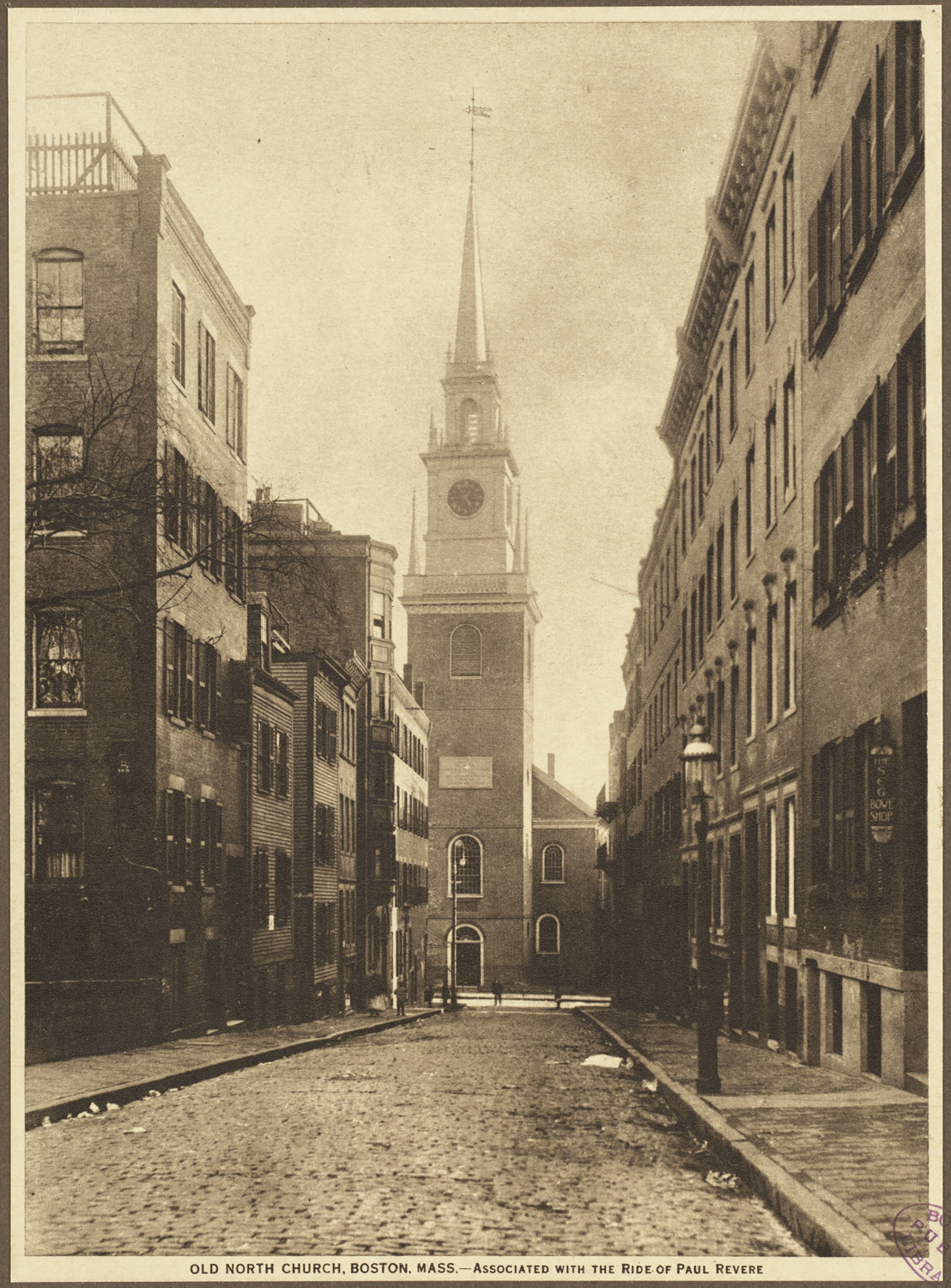 |
| Vintage Photograph of Christ Church, or the Old North Church, in Boston, Salem St. |
My mother has been delving more and more into our family histories of late, and has opened for me a compelling story about our lamp-lighter ancestors. John Pulling Jr is my seventh great-grandfather. He is indeed mentioned on the Old North Church website. On 18 April 1775, vestryman (a leading member of the church body) John Pulling and sexton (caretaker) Robert Newman hung lamps in the steeple window of the church to warn colonial citizens that the British were on their way to Lexington and Concord. Revere rode on across the harbor, spreading the word in person. H.W. Longfellow, who wrote the poem "The Midnight Ride of Paul Revere" honoring his ancestor, does not mention John Pulling. If you look up the story on Wikipedia, the grand bastion of
drive-through history, John Pulling is absent and the credit for
lighting the lamps goes to Robert Newman.
(As a side note, Michelle and I walked the Freedom Trail a few years ago and our Yankee-garbed guide gleefully told us that Revere was drunk that night. I sincerely doubt this - it would be a gargantuan effort for a man to ride a horse through the dark, over the Boston Harbor while evading British troops and successfully warn the colonists for what would be the battle of Lexington in a state of intoxication. The idea sullies the efforts of these men.)
John Pulling Jr, a Mason and a merchant, was married to Sarah Thaxter McBean. This was the second marriage for both. She was first married to Duncan McBean, a landowner/businessman, who died shortly after their return voyage (presumably) from the Caribbean. Their infant child also died on that journey. John's had two children from his first marriage to Annis Lee, John and Annis. Together, John and Sarah had two more children, Martha and Sarah, called Sallie. Sallie is my sixth great-grandmother.
John and Sarah both strike me as strong, passionate people. John, a vestryman (leading member of the church), was part of the Sons of Liberty with Revere. On 16 December 1773, John was one of a group of men who, protesting the British tax on tea, went to Boston Harbor and threw an entire shipment of tea into the water - the incident was later dubbed the Boston Tea Party. John Pulling stashed tea in secret compartments in his writing desk. That desk has since gone to another branch of the family - but it most certainly does exist.
Paul Revere and his fellow Sons of Liberty were doing everything they could to thwart British advances by hiding munitions and arming themselves, as tensions grew and battles erupted in the colonies. They had a simple code planned for a lantern-signal: one by land, and two by sea. On this particularly night, the British troops moved faster than predicted, and Revere borrowed a horse and ran west to warn the colonists while Newman and Pulling ran up to the steeple and briefly flashed two lanterns in the window. This alerted the colonists, but also alerted the British, who converged on Christ Church.
 |
| The Old North Church looking toward Boston Harbor. by Chris2fer |
They apprehended Newman who had climbed out of a window. During the subsequent - and no doubt unpleasant - interrogation, Newman gave up John Pulling's name. Now indicated in the treasonous act, the British searched John's home, which was in the neighborhood but did not find him or his family. John was actually hiding in a wine cask in the cellar. Sarah, having sewn the family's silver and strips of tea into her petticoats to get it passed the British, had fled with the children to Cohasset, Mass. to hide in a cooper's shop (that's a maker of barrels and casks). According to our sources, the shop was little more than a shack. Sarah would later give Martha in this hiding place.
John, disguised as a fisherman, rowed a skiff to Nantasket (up the beach from Cohasset). He joined Sarah and the children in Cohasset where they hid until the British left Boston later in the war. The family had fled with very little in the way of belongings, and had only each other. John was never caught, but his life was changed. A traitor to the Crown, his property was seized and he lived as a fugitive, in hiding and suffering, until his death nearly twelve years later. He died at age 51 and is buried in Boston.
John, disguised as a fisherman, rowed a skiff to Nantasket (up the beach from Cohasset). He joined Sarah and the children in Cohasset where they hid until the British left Boston later in the war. The family had fled with very little in the way of belongings, and had only each other. John was never caught, but his life was changed. A traitor to the Crown, his property was seized and he lived as a fugitive, in hiding and suffering, until his death nearly twelve years later. He died at age 51 and is buried in Boston.
After John Pulling died, Sarah took the children to live in the town of Abington. There Sallie would marry Isaac Reed. Their daughter Lucy would eventually marry her second cousin, Jesse Reed. To make the situation even more confusing, Sarah herself married (for the third time) another Thomas Reed, Isaac's father. And the rest is history. (My great-grandmother was a Reed who married a Poland. My grandmother married a Pike. My mother married a Boston. From Sarah and Sallie on down we have a history of strong women in our family. Not to cast all of my fathers and grandfathers aside...)
But it isn't "just" history. I am connected to a family legacy - not of famous poems and bronze busts in museums, ballads and paintings and statues - of sacrifice and loyalty to family. John Pulling Jr in every way exemplifies what it means to be an American and a Christian. He committed treason; had he been caught, he most likely would have been executed. Dying an early death, leaving his family destitute and exiled from home, is not a pretty story. But what is beautiful about it is its plainness, its honesty, and its hope in something beyond the reach of the British Empire, beyond the grave.
The next time I am in Boston, I will definitely visit the Old North Church, find the pew that bears my great-great-great-great-great-great-great grandfather's name (if there is one), and thank him for being there all those years ago to strike a match and light a lantern, knowing full well what would happen next. I can only imagine what that felt like.
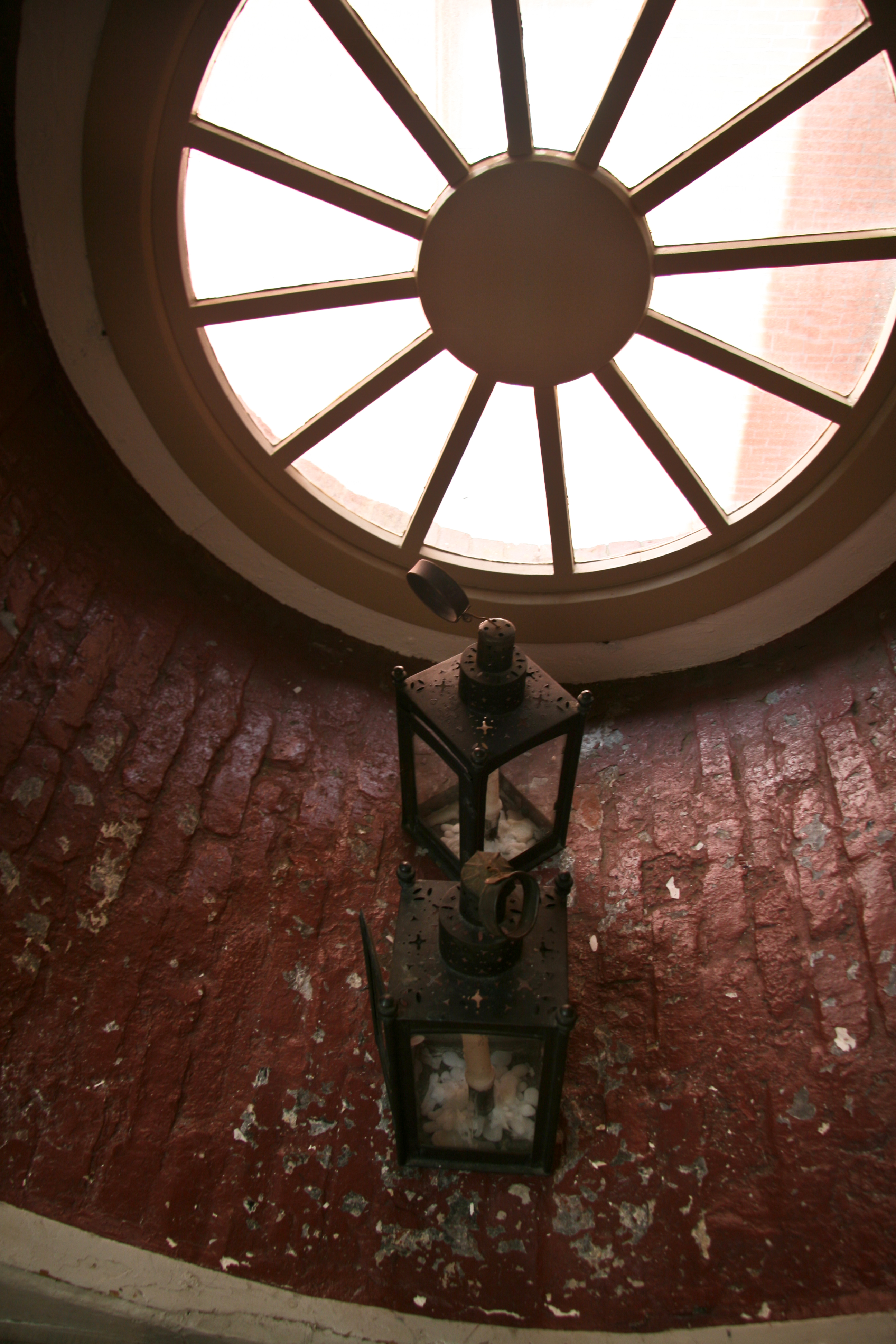 |
| Old North Church #3 by Tim Sackton |
Thursday, April 17, 2014
Rebecca Again
As spring comes on, I find myself revisiting my favorite novels. It is the mark of a good, excellent, even masterful novel, if they call to us even after we've read them, to come back and explore a story all over again, discover new nooks and crannies and the secrets buried in them. Spring began with Jane Eyre (Charlotte Bronte), I Capture the Castle (Dodie Smith) and Rebecca (Daphne Du Maurier) - reviving a spirit of the classic, ageless stories that have inspired, compelled or comforted me in my work.

I just finished Rebecca for the second time. It is the newest of the three to my experience. Jane has been with me since high school. And Cassandra (I Capture the Castle) just after I graduated college. An article on NPR stirred up an interest in Rebecca, and here I am, reading her again. A few weeks ago I'd made up my mind that Rebecca was one novel I should have in my collection - I needed it in that odd, frenzied writerly way. I know I will come back to it in the future time and time again. I wanted it with me ready to be taken down and studied, just as Jane Eyre and I Capture the Castle are.
Rebecca's opening line is famous and ghost-like "Last night I dreamt I went to Manderley again." It is more deeply psychological, sitting in the heart of the young (and nameless) Mrs. de Winter's story and looking out on the traces left of her husband's first wife. The narrator's experience colors so much of the novel - her suspense is our suspense. When she is shaken, we are shaken. I could write paragraphs upon paragraphs of how Rebecca draws on Jane, how they're similar, how each is its own unique work of art, but perhaps in another post. For the moment, I am quite content to bask in the sunshine and the shadows of these two works... a house of secrets, a wife's hidden nature, a husband's torment, a second marriage threatened, a haunting sadness, a love of place and nature, hauntings of the living and the dead.
I love Ms. Du Maurier's attention to detail - how those details paint character as well as scene. In the beginning of the tale she introduces the narrator's employer Mrs. Van Hopper thus:
... how different my present companion, his steady, well-shaped hands peeling a mandarin in quiet, methodical fashion, looking up now and again from his task to smile at me, compared to Mrs. Van Hopper, her fat bejeweled fingers questing a plate heaped high with ravioli, her eyes darting suspiciously from her plate to mine for fear I should have made the better choice... (p 10)
Rebecca herself is dead, but she's alive in the imagination of Mrs. de Winter, eclipsing her, overpowering her from beyond the grave:
I must have been the first person to put on that mackintosh since the handkerchief was used. She who had worn the coat then was tall, slim, broader than I about the shoulders, for I had found it big and over-long, and the sleeves had come below my wrists. Some of the buttons were missing. She had not bothered to do it up... There was a pink mark upon the handkerchief. The mark of lipstick. She had rubbed her lips with the handkerchief, and then rolled it in a ball, and left it in the pocket. I wiped by fingers with the handkerchief, and as I did so I noticed that a dull scent clung about it still. (p 120)
Her description of Mrs. Danvers, the housekeeper:
Someone advanced from the sea of faces, someone tall and gaunt, dressed in deep black, whose prominent cheek-bones and great, hollow eyes gave her a skull's face, parchment-white, set on a skeleton's frame. (p 67)
I could go on and on and on, but then my thoughts on Rebecca would be as long, or even longer, than the book itself. It is a masterpiece because every word, every detail is carefully placed for the best affect - the subtlest, most stirring metaphors. The very novel is alive - gorgeously reflective of Manderley itself: a grand old house, well-kept and beautiful but unable to contain the wild spirit stirring at its heart.
You should read Rebecca...
... if you love Jane Eyre. Don't compare them seriously (as to which is the "better" because they're both very different) - just enjoy their similar shades of story
... to catch a glimpse of the restless Cornish sea
... for a compelling, page-turning mystery wrought with lingering grief and silent rage
... for mouthwatering descriptions of food and gardens you can almost smell... the azaleas! the roses!
Thursday, March 6, 2014
Worthy Read: The Magicians & The Magician King by Lev Grossman
Here's a worthy read that has been on my mind lately: Lev Grossman's The Magicians and the sequel, The Magician King. The third novel is due out this summer.
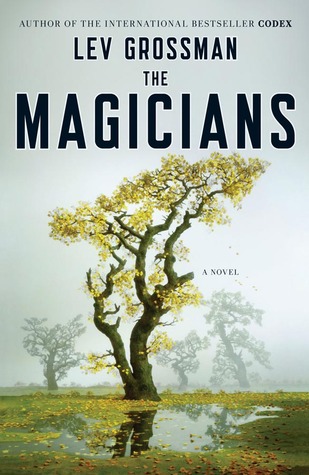
Lev Grossman has created a world both familiar and fresh. The novel is, of course, about magic - but only like Harry Potter in the most shadowy sense. Instead of a boarding school for young wizards, these are decidedly adult novels - complete with salty language that would make Ron Weasley blush - about a young man named Quentin Coldwater who is admitted to an obscure American college called Brakebills to hone his magical skills. The funny name is where the similarity to Hogwarts ends. Quentin is a bit of a nerd, obsessed since childhood with the Narnia-like books of children's adventures set in a magical land called Fillory. When he finds himself at Brakebills, he realizes that living in a magical world doesn't suddenly make things easier or better. Like any kid in college, he makes new friends, falls in love, and makes a ton of mistakes - some arrogant, some innocent, some reckless. Quentin's journey I find is so true to the post-college experience - that what we learn in class or inside the college walls with our friends cannot ever fully prepare you for the real world. It is even more true for a magically dangerous world. So even when Quentin and his friends do finally stumble upon Fillory, it isn't the paradise that he always imagined. In fact, it might be more sinister than he handle.

The Magician King is a powerful sequel, broaching the question of what happens after one has become king over a magical land. Fillory has lost its potency, and we slowly learn the story of Quentin's bitter and emotionally scarred friend Julia, who was rejected by Brakebills and fought and suffered tremendously to learn magic on her own. Quentin is still coping with the horrors he encountered in the first novel - of disappointments with Fillory, of needing to find out who he is in this aftermath. The Magician King is about the consequences of living a magical life and whether it is worth the sacrifice.
You should read The Magicians and The Magician King
... if you enjoy crisp, sarcastic and hilarious prose.
... if you're search for a fresh, original and terrifying story.
... if you want a story with vivid individuals for characters, none of them perfect, but (irritatingly) human and heart-breaking.
... if you have trouble letting go of Narnia, Neverland or Middle Earth.
But, to harken back to Reading Rainbow, you don't have to take my word for it.
Thursday, February 13, 2014
Winter Seeds in Querying Season
On Writing - dolce memole
(Wait. Isn't a query supposed to be like a book jacket? Not exactly. Shorter than a book jacket. Very short. Three paragraphs tops, people, and no more than 300 words to demonstrate your ability to work with Less. Not three paragraphs for the book and two for an intro and a wrap-up. One paragraph to tell an agent why you're querying them. One hook paragraph for the novel. Third paragraph to give "credentials" or writing credits. That's all she wrote. Literally.)
It took about a month of chiseling away at the query and the even uglier synopsis. With Michelle's coaching, something promising emerged. I researched a handful of agents and sent out the first three last week. I braced myself for a round of form-rejections like before saying, "Thanks but no thanks," or "your novel is just not right for us" etc. The same day I got what I'd been praying for over the last year: just one personalized response from an agent.
It was not a yes, mind, but a paragraph or two of some really helpful insights into the story I am building. I was not necessarily looking for a "yes", anyway, but some sort of confirmation that my novel isn't crap, that it has a future apart from a query slush pile. And here it was. It was not "yes" but it was helpful, friendly, and encouraging.
What the agent said was (paraphrased), "Awesome idea - but... here's what I was hoping to see..." In other words, here's how I could possibly make it better. I know it could be better.
First of all, she saw the story (despite its flaws) from a query, a synopsis and 25 pages. She was convinced the novel could be More. I still need to work on "showing" rather than "telling", particularly when it comes to setting and how it shapes the world in which my characters' lives unfold. (Honestly, that's something I know I'll always be working on.) The problem isn't the space I'm trying to build, but my tendency to reveal details and nuances in dialogue. Third, my characters should be allowed to flourish (her word) even more. I was beyond excited when she recognized their connection... I thought, "someone who understands..."
This response was an indication that, at least for now, I am headed in the right direction. Not only have I crafted a stronger, more professional query letter and synopsis (Thank you again, Michelle!) but I have a plan to make the writing itself - the meat of my novel - stronger, too. I know Waterwill will be a fluid thing for years until its published. (Okay, if it's published. But I like optimism.) The next draft will be about vivifying the setting and the characters' personalities and relationships, as well as paying very close attention to the balance of dialogue and exposition.
I know she is not my agent, and I won't presume that she'll leap on it if I send her materials a second time. Yet this experience has given me hope that someone will find and connect with Waterwill further down the line. I have hope that my novel, while still not quite "there," is closer than ever to where it needs to be.
That said, I've been marking up my drafts with vivifying and show-don't-tell ideas. For now, I'll hold off querying other agents on my list because, frankly, I want to give out my very best. I'm excited to be able to strive for it, to have a direction. Excited. Encouraged. Increasing momentum. I might have a different perspective on that in a month or two, but for now everything feels right - even if I'm still in the same place, between queries, agentless.
It may still be winter, but remember that seeds are sewn in the wintertime. Roots dig deeper. On the surface it may appear that the world is resting, but life is flourishing beneath the snow of Querying Season.
snow days by madeline gibson
Wednesday, February 5, 2014
Long Time No See!
It may seem quiet here on the blog, but it's been a busy, busy couple of months for me. Ideas for posts occasionally circle my brain, only to be swept away by something more immediate or exciting. But there's good news: the year is still fresh, and my energy is getting back to where it was.
Timeline of Events:
28 November - Thanksgiving
29 November - Jillian gets on a plane bound for the UK
30 November - Jillian and Michelle are reunited in Oxford and a ten-day visit begins.
30 November to 9 December - Jillian and Michelle spend time hanging out at coffee shops (particularly Cafe Nero at Blackwells) reacquainting ourselves with our old haunts, watching Chuck, Farscape, Haven & Doctor Who, going to pantos, taking walks, writing, Christmas shopping (the glorious Scriptum on Turl Street), taking cold medicine, etc.
Highlight, 6 December - Jillian goes to London by herself as she unwittingly gave Michelle a cold. Visited St. Paul's Cathedral and the Tower, navigating the London Underground solo. Not a small feat for one born and raised in a Midwestern state that has no subway system.
9 & 10 December - the weary traveler makes it back to Nebraska and drives from Omaha back to Lincoln.
11 December - Jillian's car battery decides it doesn't like the frigid weather and promptly dies in the driveway.
Highlight - Jillian starts looking for a new apartment for herself and Ninja the cat.
25 December - Christmas.
6 January 2014 - Jillian finds a lovely little place with a view of Nebraska's capital.
18 - 21 January - Jillian and Ninja move house. Ninja puts up a fight characteristic of, well, a highly skilled ninja.
Since then, it's been a matter of unpacking, rearranging, realizing what kitchen utensils I need, what furniture is still in limbo, getting a cat to adapt to new surroundings without a basement to throw her into. All the while I've been painfully aware that I've not sent queries out for my novel in a long time, and that I need to get that particular wheel moving again.
Perhaps it's just taken this long to regain my strength, my mental resolve, and keep at bay all of those doubts and devil voices that like to me that querying is useless, that my novel is crap, that I don't have a strong presence online anyway so why bother. When you're anxious person, this is the reality, and it's just not helpful. It drives you away from your everyday writing, the heart-stories and creative activities that define your day, your sense of self. I don't want to give it up or shrink away so easily this year.
I want this year to be about forging ahead and hesitating less. Call it a resolution if you will - or perhaps solemn goal is a better term. Whatever it is, querying is one of those stages in the life of a book that can't be bypassed or jumped over or TARDIS-ed into oblivion. No, the Doctor isn't going to pull me out of this one. I have to do it myself.
So I sent three queries this morning. At the very least, I hope I'm continuing to learn something about this process, to think of this as a project and an opportunity and a leap of faith. I am simply starting down the corridor again, and knocking on the doors. Some day one of them will open.
open doors by kuronakko
Tuesday, December 24, 2013
A Spritz Christmas
When I was little, I came into a cookie tradition. My parents were critical care and intensive care nurses who balanced their schedules so that someone was always home with their little girls. Cookie-making was a way for keeping us busy. And Christmas, of course, is the Season for Cookies.


Mom eventually stopped making the spritz cookies. You can't really blame her. They're difficult to make and time consuming. They're mostly butter and sugar, and are small enough that a handful are eaten at a time - the antithesis of a healthy diet. But. It's Christmas.
The spritz cookies would always ALWAYS go into the same blue tin. Every year. My parents tried to get rid of it years ago, but I took it with me because... well, my mouth waters and I sniff for that almond extract and vanilla smell every time I lay eyes on it. Rest assured it has been washed several times since the '90s, but it is still "the" tin. I was a kid listening to Grampy's Christmas tape, Julie Andrews was singing "Jingle Bells", and there was spritz cookie dough in my mouth (ah, the BEST dough EVER) and imagining the horse was really pulling that sleigh all the way around the tin.

What I appreciate about the cookies now is how easy they are to freeze and to give as gifts. They go great with tea. They're pretty and colorful without a thick smothering of icing. They're bite sized (in some cases). They smell heavenly. Even as I make them now, I feel like that little kid aching for a taste of the dough, eager to mold it in my hands. There is nothing quite like spritz cookie dough getting soft and buttery between in the fingers. And as a writer, I find I need to cookie - do something purely tactile and savory - to get my brain working. Kneading bread dough, chopping potatoes, simmering wine, decorating cookies so that they look like snowflakes - it all creates room in the brain for those stories to grow, to simmer.
The best Christmas gifts involve food and drink and sharing it with others. Back in September I thought I should write stories and give them to people this Christmas. That didn't happen. Little stories aren't easy for me, and with the double stress of a trip to England in the first part of the month and a move sometime in the near future I turned to the simpler plan of cookies and puddings. I'm glad I did. These treats help us face the long dark of another winter of resolutions failed and met, of more snow and shivering and dying car batteries.
This winter I'll be back to getting those query letters out to potential agents. I'll be looking for my first solo apartment. I'll be writing a sequel to my novel and dabbling in the revamp of another. I'll also have a few spritz with my tea, while my supply lasts.
And who knows? I might make more for St Valentine's Day.


Every family has its special staple cookie - the one that has to be made each year in the same fashion because it won't be made at any other time of the year. Cookies were an escape, a wonderful, creative distraction from the terrible weather, wet or dry, that characterizes Nebraska's bleak winters, mid- and late. Without cookies, I somehow believed, Christmas wouldn't really come.
We made spritz cookies and almond bark-pretzel-m&ms cookies. The latter isn't really a cookie, but they were special. Circle pretzels, with almond bark poured in and red and green M&Ms in the middle. Before I was old enough to melt the almond bark myself, I remember watching Mom or Dad pour it into pretzels - there was something magic in watching the white sugary stuff fall from the spoon - pure liquid white. As a child with a particular penchant for all things sugar and chocolate, this was a beautiful ceremony. Still is, actually.
We did not make sugar cookies often. I know we had the cookie cutters - stars and Santa Claus and Christmas trees - but they sat in a jumble in the kitchen drawer while Mom got out the old spritz cookie press and made a dough of flour and sugar and butter (three sticks), vanilla and almond extract: the aroma of the season. I still have the old press. Most of the parts are metal, and the thing is most likely twenty-five years old or older. It's finicky, and falls apart easily. I have a brand new plastic press that works like a dream, the latest in cookie press technology, but...
"Haven't you thrown that old thing out yet?" Mom will probably ask when I visit for Christmas. Well, no. So much of my childhood is wrapped around this device, so many hours of watching her labor over a cookie sheet, pulling deformed blobs of proto-cookie off the sheet and begrudgingly throwing it back into the dough bowl. She'd work until the pan was full of trees and stars and wreaths. Then my sister and I would descend with the colored sugar and the red-hots. The old press doesn't make the cookies easy, but it did make it Christmas. In the days when I imagined Santa dropping into our mantle-less house (we did have a chimney, but no fireplace), we always made sure there were spritz cookies waiting for him.

 | |||
| The don't make them like they used to. |
 |
| I'm thinking that this box might make an awesome handmade cover for a cook book. |
Mom eventually stopped making the spritz cookies. You can't really blame her. They're difficult to make and time consuming. They're mostly butter and sugar, and are small enough that a handful are eaten at a time - the antithesis of a healthy diet. But. It's Christmas.
The spritz cookies would always ALWAYS go into the same blue tin. Every year. My parents tried to get rid of it years ago, but I took it with me because... well, my mouth waters and I sniff for that almond extract and vanilla smell every time I lay eyes on it. Rest assured it has been washed several times since the '90s, but it is still "the" tin. I was a kid listening to Grampy's Christmas tape, Julie Andrews was singing "Jingle Bells", and there was spritz cookie dough in my mouth (ah, the BEST dough EVER) and imagining the horse was really pulling that sleigh all the way around the tin.

What I appreciate about the cookies now is how easy they are to freeze and to give as gifts. They go great with tea. They're pretty and colorful without a thick smothering of icing. They're bite sized (in some cases). They smell heavenly. Even as I make them now, I feel like that little kid aching for a taste of the dough, eager to mold it in my hands. There is nothing quite like spritz cookie dough getting soft and buttery between in the fingers. And as a writer, I find I need to cookie - do something purely tactile and savory - to get my brain working. Kneading bread dough, chopping potatoes, simmering wine, decorating cookies so that they look like snowflakes - it all creates room in the brain for those stories to grow, to simmer.
The best Christmas gifts involve food and drink and sharing it with others. Back in September I thought I should write stories and give them to people this Christmas. That didn't happen. Little stories aren't easy for me, and with the double stress of a trip to England in the first part of the month and a move sometime in the near future I turned to the simpler plan of cookies and puddings. I'm glad I did. These treats help us face the long dark of another winter of resolutions failed and met, of more snow and shivering and dying car batteries.
This winter I'll be back to getting those query letters out to potential agents. I'll be looking for my first solo apartment. I'll be writing a sequel to my novel and dabbling in the revamp of another. I'll also have a few spritz with my tea, while my supply lasts.
And who knows? I might make more for St Valentine's Day.

Wednesday, October 30, 2013
Real Ghost Stories
This summer I was told a ghoulish story after dark in an old Civil War-era cemetery.
A group of friends and I had spent the afternoon out in the country in our friend Neal's uncle's pasture in south central Nebraska shooting pistols, shot guns and scope-rifles. This was a new experience for many of us city folks. We'd climbed into the back of Neal's pick-up - some of us hanging on in the back - and he took us over hills and ruts and around grazing, jaded cows to the place where he'd set up targets. We plugged our ears, shot at Diet Coke cans with a scope-rifle, hit clay pigeons with a shot gun and generally had a good time as the sun went down and the full moon showed its face.
Neal told us the pasture we were shooting in was not far from the site of an Indian battlefield. It turned out to be the prelude to the night's next activity. He took us over dirt roads and onto a path that meandered down through and behind a corn field. At the end of this road was the Farmers' Valley Cemetery - complete with the Nebraska marker - tucked away out of sight.
Among the graves were Civil War veterans and their families, some of the first settlers of in that area, children who had died young in skirmishes with the Sioux. It was the quintessential prairie graveyard, small and understated, rich in history. We walked around with flashlights, looking for names of the veterans, amazed that the stones were still legible even after 150 years. Then, as the night breeze picked up and got chilly, Neal told us a chilling tale.
 |
| I took this photo as we left. It was about 11 or midnight. |
Among the graves were Civil War veterans and their families, some of the first settlers of in that area, children who had died young in skirmishes with the Sioux. It was the quintessential prairie graveyard, small and understated, rich in history. We walked around with flashlights, looking for names of the veterans, amazed that the stones were still legible even after 150 years. Then, as the night breeze picked up and got chilly, Neal told us a chilling tale.
He and his brothers had been staying in a cabin not far from where we were standing one night several years ago when they heard the sound of hammering and incantations. Needless to say, they lay in terror that night. The next morning, one of the flat stone-slab graves had been broken into and the body removed. Later on, a group of satanists were arrested in connection to the theft. Neal told us with a deadly-serious expression that these satanists had planned to smoke the bones. When we saw the grave, the stone shards were patched, but the evidence of their task remained. A chill traveled down my spine. Something rustled far off in the trees, or perhaps in the corn field. My spine tingled. We all shivered.
It was hard to tell with Neal's expression if he was kidding us, or if he'd invited friends along to scare the living daylights out of us. We saw no ghouls, living or otherwise, but I know I felt something... some awareness of the past that hadn't been there before. The dark deeds of others can mark a place in ineffable ways.
It was hard to tell with Neal's expression if he was kidding us, or if he'd invited friends along to scare the living daylights out of us. We saw no ghouls, living or otherwise, but I know I felt something... some awareness of the past that hadn't been there before. The dark deeds of others can mark a place in ineffable ways.
I kept thinking about the story of the theft of bones and how the real mysteries of this world are the living ones.
In August, just weeks after the group of us had been there, an eighteen year old was arrested for vandalizing over 50 tombstones in Farmers' Valley. He was charged with criminal mischief, and the local community rallied together in September to begin repairing the damage. A Journal Star article conveys the sense of loss this act created; the cemetery is history, personal history, and it must be guarded and cared for and visited. I am so glad I saw it when I did.
I've found the Farmers' Valley Cemetery on Rootsweb, which tells the story of Marion Littlefield's death in battle with the Sioux, the arrival of Scottish settlers to the area, and the hard lives that were lived out here. This little slice of history is just south west of Henderson, Nebraska in Hamilton Co. Oh, the stories this ground can tell.
In August, just weeks after the group of us had been there, an eighteen year old was arrested for vandalizing over 50 tombstones in Farmers' Valley. He was charged with criminal mischief, and the local community rallied together in September to begin repairing the damage. A Journal Star article conveys the sense of loss this act created; the cemetery is history, personal history, and it must be guarded and cared for and visited. I am so glad I saw it when I did.
I've found the Farmers' Valley Cemetery on Rootsweb, which tells the story of Marion Littlefield's death in battle with the Sioux, the arrival of Scottish settlers to the area, and the hard lives that were lived out here. This little slice of history is just south west of Henderson, Nebraska in Hamilton Co. Oh, the stories this ground can tell.
Wednesday, October 23, 2013
"I should be" Versus "I am"
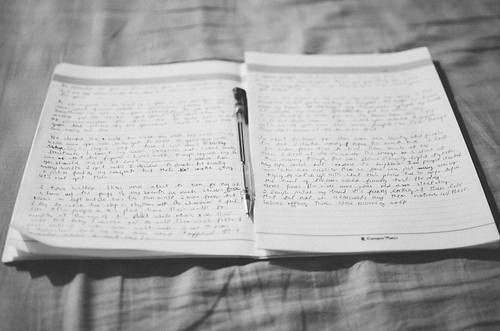
"Write and forget the rest of the world" by Mary Grace Ardiente de Castro on flickr
I often find myself plagued by the ubiquitous word "should." This author does this, therefore, I should be doing that, or I must do that. The work clicks in when I measure myself against the success of other authors: failing to make a thousand or more words on a page, not getting anywhere with agents, not having time for my online writing community. For whatever reason, negative messages pop up in brain like weeds and choke out all the good beautiful foliage that should be there:
- "I should have been trying to get pieces published in high school."
- "I should be getting up at 5 a.m. to write and fulfill a word quota for the day."
- "I should have been done with that story by now."
- "I should write this one story because it seems marketable."
- "I should be blogging at least once a week, in a witty and engaging manner using lots of graphics, video and subliminal messaging."
- "I should be tweeting and posting on Facebook and commenting in articulate paragraphs on other blogs and writing reviews on Goodreads and making social connections and...."
- "I should have more to show for my writing career."
- "I should go to that one writing conference because all the other up-and-coming writers are going, getting advice, getting agents."
- "I should be an extrovert."
- "I should be able to write anywhere and everywhere, even with a jackhammer right outside the office window."
- "I am doing this all wrong."
None of these are necessarily true, although it is strange how much we believe them. And when, say, I physically cannot get myself out of bed at 5:00 to write, the whole day is ruined before it starts. "I'm a bad writer! I can't get my act together! I'm not disciplined! I only wrote one whole sentence today!" And what of these fantasy writers who are getting agented all over the place? Is this really true? Is it really that easy? Or is it just part of the negative static clogging our creative minds, keeping us forever in the past?
So we're not like that hypothetical group of successful, smiling, rich, creative, brilliant people. They are an illusion. No one has an easy writing life. Writing is freaking hard. Period. Writers come on a vast spectrum of disciplines and habits and quirks. You may not be able to function at the writing desk without a shot of whisky, or maybe you need complete silence. Some write in bed. Others on the subway. Some can write in little snatches on the go, others need to stick close to home base. Or if you're Dan Brown, you need to hang upside down to get the creative juices flowing. Where you fall on the spectrum of discipline and a quota of words is part of you.
The point is we should be focused not on the writers we think we should be, but on the writers we already are and what we're accomplishing now.
I'd thought the whole scenario of getting up early and getting work done made perfect sense. And it did for a few days. It did feel awesome to be up at 5:30 and writing away, but the weekends came, I'd sleep in and it turned out to be a very difficult routine to maintain. I'd panic - there was no time or mental space to tinkering with my WIP at work (jackhammer noises coming from the elevator shaft - there is no quiet way to disassemble and replace an elevator) and by the time I'd get home, I'd be too beat to do anything creative. Coming home at night is the bookend of the day - things are winding down, kitty needs to be fed, the trash taken out, my dinner made, the dishes washed, the shower taken. So I've been spending time at a coffee shop not far from work for an hour to two afterwards. I have found more enjoyment working there at my own pace, without the constraints of time than when I was forcing myself out of bed at an ungodly hour. Who knew?
I haven't been measuring word counts, either, because I feel - especially with a tentative draft - it is a great way to perpetuate loads upon loads of meandering Nothing. I cringe at the idea of National Novel Writing Month, of having to spit out 1,667 per day with little room for thoughtful brainstorming or rest. But that's okay. Many people enjoy the exhilaration of diving right in, to "get 'er done!" as the great Nebraska philosopher Larry the Cable Guy says. It just doesn't work for me. There are times when quantity cannot replace quality.
Personally, I feel like I've spent a great deal of time trying to imitate those visibly successful writers, join bandwagons and get swept up for a spell in a particular creative zeitgeist. I joined Twitter only to panic that no one was paying attention to me and that I couldn't write a 143 character tweet to save my life. Nor did I have the energy to dance across the internet leaving an electronic trail of comments, shouting "I'm out here! Pay attention to me!" I hated myself for trying.
There is no magic formula for success, particularly success in writing. No set time frame. No standard career plan. And yet we still believe that if we hang upside down just like good ol' Mr. Brown, we might be just as successful - a wide readership, bestsellers, movies, mansions. If we're smart or well-read enough we might get the Man Booker Prize like 28 year old New Zealander Eleanor Catton did this month. And... if we don't we tend to think, "hey, I'm 28. I must have missed the mark and my big break. My life is forfeit." Bah.
The things we tell ourselves.
Of course, there isn't anything wrong with social media, with conferences, with challenging yourself, but in the day to day, while we're in-progress and still working full-time jobs, it is so much better to focus on the gifts and the circumstances we were given to continue on with our work. To write because we're compelled and made to write, not to conquer everything in one day or judge the whole of one's budding career by a string of bad days or where others tell us we should be. If we're trying our best to hone our craft and navigate the publishing world, that's success. Success might take years and years. It doesn't matter what it looks like to anyone else.
I return to Anne Lamott's advice about the one-inch picture frame: tiny assignments - write one description, one little sentence and see where it takes us. And from there, just write moment by moment. Focus on what can be done today, or this hour, or until the baby wakes up from his nap, not what "should" be done in a week or even a month. Otherwise, writing becomes the ultimate in Sisyphean feats. We must follow a string, a stepping-stone path of little goals - keeping the future in mind but not comparing goals to others' achievements. We're not "there" yet, but we will be. When we do get there, it will look worlds different than how we imagined it. Our job for now is simply to hang in there. How you "hang" is completely your choice - not Dan Brown's, Stephen King's, Margaret Atwood's or Charles Dickens'.
So. Enjoy the ride. Spread your wings at your own pace, exercise them everyday, practice flying further and further toward that horizon. You'll get where you need to be soon.
Tuesday, October 1, 2013
A Study in Micro-Reviewing
I've been batting around a notion for a while that seems rather, well, obvious. I frequent the library often, and try to read a great variety of works both within "my" genre and outside of it, and yet I find myself in the habit of not sitting down and putting into words what I did (or didn't) take away from it. I have no excuse. It is important to be able to articulate why I love or loathe a certain
book - not just as a writer but as a thoughtful reader. Besides, it's just good practice. We opinions, fellow readers! We need to voice them!
I'm not a literary critic. In fact, I think a great deal of us cringe at the word. The one class from which I had to withdraw in college was a Critical Theory class in which the lecturer's unforgiving attitude toward those of an writer's mindset gave me a nasty panic attack. So... I'm not a critic, just a reader and a writer looking at the story and what it said to me. I realize it doesn't have to be an article. It doesn't have to be a polished essay. It doesn't need to be more than say, 250-300 words. The length of those pesky query letters... and no doubt easier to write. Ahem, here goes.
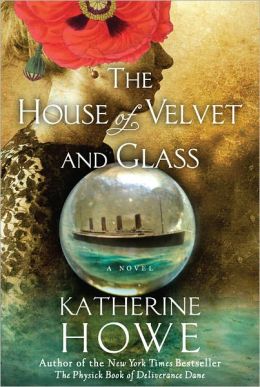
The first book in this Micro-Review series is The House of Velvet and Glass by Katherine Howe. Published in the spring of 2012, it is the second novel Ms. Howe has presented to the world. The first was The Physick Book of Deliverance Dane, an intriguing novel spanning modern-day Harvard back to the Salem witch trials. I read The House of Velvet and Glass because Deliverance Dane struck such a nice balance between historical fiction, contemporary coastal Massachusetts and a hint of magic woven throughout. Her characters were genuine and driven to uncover the mysteries presented them. Her descriptions were vivid - I particularly liked her description of the dilapidated house to which the main character returns and the mushrooms growing at the foot of the stairs. The novel was warm with hints of good witches, a magic inheritance from mothers to daughters and long-lost diaries, an October story.
The House of Velvet and Glass also takes place in Boston - this time in 1915 after the Titanic disaster. As Deliverance Dane was a story about witches and magic, Velvet and Glass is about sinking ships, opium dens and crystal balls. I did not find it to be as "entrancing" as the jacket blurb says. The main character Sibyl Allston is a spinster at twenty-seven, still suffering from the rejection of a suitor long ago and the deaths of her mother and sister on the Titanic. Her brother has been expelled from Harvard for cavorting with an actress. Her father is an old grizzled seafarer with a blue parrot. Katherine Howe, it must be said is a consummate researcher. To read Velvet and Glass is to transport yourself into the textures and the trappings of medium parlors, Back Bay mansions and opium smoke. The surroundings are vivid... but perhaps too vivid because they tend to drown the characters out to types - they're good characters with some but not great depth.
I couldn't get close to the characters. Sibyl discovers that using a scrying glass in conjunction with opium use gives her powerful visions; her old flame - a psychologist - tries to protect her from it; her father battles his own addictions for similar reasons. Sibyl strikes me as being a little too naive, while also being stubborn, which is irritating. Her brother of course falls in love with a woman of indeterminate class. Other rich ladies are snobbish. It's 1915 and Sibyl doesn't know that the laudanum her father takes is an opiate and therefore addictive? And - no doubt because I've watched Downton Abbey - I saw the story line of the Titanic connecting to the Great War almost immediately. It was so predictable - although I cannot rule out the idea that this was somehow intentional - and the characters helpless to do much to change their fate... even if they can see the future. I expected different, more dynamic choices on Sibyl's part.
I wonder if this is an example of Second Novel Syndrome, my term. Having made a successful debut, the author is now under deadline for the second bestseller - continuing a brand of story. Perhaps there isn't as much freedom to create and explore in this new novel; publishers and editors want a working outline, a synopsis of a novel that is still in the infant stages. In order to meet deadline, the author must work to the outline. I'm not saying this is true of Ms. Howe's experience, as I'm not in a position to ask her, but it is the sense I gather: to produce something fresh and in the same vein as Deliverance Dane but on a schedule.
That said, The House of Velvet and Glass is a thoughtful and scholarly book. Katherine Howe has painted a vivid picture of 1915 Boston - showing us how the mediums (charlatans) turned their tables, what the scientific minds at Harvard thought about visions of the future, and the inheritance of addiction. There are beautiful moments and graces, fiery kisses and apparitions, a dance in the ballroom of a sinking ship. Despite its flaws, it is a beautiful book. It is not an epic but a slice of life, and it doesn't have to be more than that.
This review is actually about 500 words. See what happens when you start small?
Saturday, September 14, 2013
Nugget of Wisdom
One little nugget of wisdom I ran across today: Lev Grossman, Time magazine critic and author of The Magicians, is "stepping away from the vehicle," much in the way that Anne Lamott would say to get out of your story's way. He explains in a current post on his blog.
Thursday, August 29, 2013
Through the Keyhole
"Hey, Jillian!" you exclaim. "Where've you been? You haven't written about anything since the garlic! And you haven't changed the 'weekly quote' in weeks!"
"Around," I say, casually. "Reading fabulous books. Working on the first draft of a complicated novel. Trying to get involved in an online writing group called Scribophile. Disciplining a cat. Ya know?"
"Really? Is that all?"
No, really. I do feel at times that I'm galaxies away from Daedalus Notes, and it's hard to get back when so many other things are filling my head. Such is the life of a writer: there never seems to be enough time or mental energy to give everything the attention it needs. Sorry about that, readers!
Anyway.
You know I've been waxing poetic about Anne Lamott's Bird By Bird lately. I read it twice in a row. I'll probably buy it so that I can read it a dozen more times. She simply speaks my language - not just because she understands the plight of passionate but anxious writers, but because she has conveyed wisdom in helpful, beautiful little metaphors richly sprinkled throughout her book. One little image to which I keep returning is that of the one-inch picture frame: this focus beyond the storm of self-doubts and distractions that plague her when she first sits down to write. It is a starting point, a little assignment to stoke the fires, silence the doubts and carry on. And I love it. She says:
"It reminds me that all I have to do is write down as much as I can see through the one-inch picture frame. This is all I have to bite off for the time being. All I am going to do right now, for example, is write that one paragraph that sets the story in my hometown, in the late fifties, when the trains were still running..."(Bird By Bird, page 17-18.)
This image has come back to me repeatedly in the last several weeks. A one-inch picture frame is tiny, perhaps the size of a locket. It only has so much room to stay something. Either you'd have to write in tiny, infinitesmal print or choose your words carefully.
And then I happened to wander into Michael's, which is usually where I find myself on a casual artist's date. There is so much - I don't know - possibility in craft stores. I've always been excited by scrapbooking papers and embellishments, special pens and the smell of new journals. In the midst of my perusal of clearance and sale items, I happened across a little (cheap) 2-inch picture frame, as well as a stack of fun Victorian-esque craft papers: images of keys and sprockets, flowers, butterflies, old letters and turn-of-the-century lovers under an umbrella. And... a little image of a fancy keyhole. Something clicked in my head. And this is the result:

The frame is roughly 2 inches by 2 inches, but the keyhole itself is roughly one inch, and even tinier in places. I have it on my desk to remind me of the starting point, beginning with the scene glimpsed through this tiny opening... so tiny you have to press your eye to it. (Pretending of course, that it's a real keyhole below a doorknob in some deliciously old fashioned house.) Only one image can fit in that little space, only a few words of truth, but they will launch you nonetheless.
So my frame and Ms. Lamott's frame are a little different, but I feel we understand each other. The frame isn't what really matters - this $2 plastic-pretending-to-be-copper frame and a little piece of cardstock - but being able to silence all the noise in one's head so that we can finally sit down and listen to our hearts. Focus on the keyhole, the squint, the slats between the blinds and write what you see, however you see it!
See you around!
Saturday, August 3, 2013
A Discovery of Garlic
It is finally August. The air is thick with late summer humidity, the drone of cicadas and crickets, the smell of lavender, thunder storms and dry grass; the sun is at its strongest, its most radiant. I've been out tending to my bit of earth and weeding as much I can around the side of the house where the roses are riding out the heat. I have what you might call a greenish thumb: gardens enchant me and I'd like to plan and sculpt and keep a garden someday when my situation is a little more permanent. Until that day, I am enjoy the garden as a place of discovery and endless musing. This is good exercise for the writer's brain.
One such discovery this week was that of wild garlic clusters growing up where the irises are situated on the south side of the house. Granted, in the few years I've lived here I'd always wondered what those white pod-looking things were but always tore them out in an effort to maintain order and never once thought to compare the shape to the typical bulb you buy in the produce aisle... or put it my mouth and bite down. I was thrilled when that taste burst across my tongue, and I instantly had the thought that if this was some post-apocalyptic world, a discovery of garlic might just be a gold mine. I wonder what Katniss Everdeen would trade for wild garlic.
 | ||
| These little garlics aren't single bulbs, but a little bundle of tiny kernels - exactly the size of popping corn. |
 | |
| Wild garlic kernels bursting from their pouch. |
This discovery sparked to life old memories of similar finds from childhood. My parents had green thumbs and hands when I was growing up: vegetables from tomatoes to squash to accidental corn; and wide variety of roses, flowering bushes and our own little patch of annuals (bachelor's buttons, zinnias, marigolds) we little ones took pride in. My parents would use mint and basil and chives from the garden, and once in a while when Dad was doing his autumn-time chipper-shredding, a wild onion would accidentally wind up in the chipping pile and get into his eyes. Once, I found a little patch of wild strawberries once growing cozily alongside the roses. I remember my little heart jumping for joy when I saw those little red berries - and they tasted so sweet - different from the ones you buy in the store.
The little strawberries made me think of the wild blueberries my sister and I discovered behind our relatives' cottage in Maine. The cottage was a rustic little house - no air conditioning, antique furniture, a tide clock (which impressed me; everything about coastal Maine, tide pools and sea creatures fascinates a child who grew up in Nebraska) and the smell of saltwater and sand. I first tasted saltwater taffy in this place, and perhaps even my first lobster. I remember scores of family members - sadly many, many of them gone - crowding into that house. And then the blueberries. We were told not to eat the berries, but we went out when no one was looking and gorged ourselves. Mom must have noticed it smeared on our faces or something because she flipped out: she thought we were eating the poisonous red berries from the bushes that separated the cottage from the neighboring plot. Until we were caught, it was heaven. Years later, we returned for a visit to find the cottage torn down and replaced with a snazzier, fancier, air-conditioned house. The blueberries were gone. It was almost as if I'd dreamt them.
I think it was the idea that you could grow food in your own backyard that thrilled me. Your own berries! Your own tomatoes! Your own herbs! My father's parents had two or three apple trees. I remember helping to pick apples and put them in baskets, and how the baskets were shaped: bucket-like with wooden slats. Gramma would make pies and applesauce. And I have the strangest recollection of being told to be careful of worms. Papa would peel the apples with a knife, which I thought was strange because Dad had a special apple-peeling device with a crank that seemed to make it so much easier. When the apple trees died, we played on the empty stumps until they were finally pulled out. Gone were our apple adventures and the climbing posts. Gramma and Papa's yard seemed so empty without them.
This love of fruit and veg thriving in the garden is still alive in me. I maintain tomatoes, peppers and beans with my roommate. We are constantly fighting the weedy grape vines (that WON'T die no matter what we do to them) that have been blocking the sunlight from the tomatoes, and the "volunteer" trees that grow between the fences. But there is something fulfilling in tending to these plants, deciding what stays or goes (if it's a pretty weed, it can stay), and discovering wild lilies or garlic... or finding that the violas, once bunny salad, have finally grown back and have flowered magnificently. There is no greater joy than that.
Gardens must be tended, but it's amazing what can grow on its own unnoticed in the shade, in the random corner of the yard, around the cedar tree, behind the shed... without having to be coddled, pruned or yanked out by the roots. Writing is this way, too. Sometimes you have to let it grow wild and rampant in order to see just what's in it.
 |
| Bunny salad no more: my violas are finally thriving. |
Monday, July 29, 2013
Thoughts on Bird By Bird by Anne Lamott
Once in a while, I stumble upon a work of prose that turns out to be a breath of fresh air and a genuine comfort to me. I've recently discovered Anne Lamott's Bird By Bird, subtitled "Some Instructions on Writing and Life." If you've not read this wise and funny little book, I recommend it.
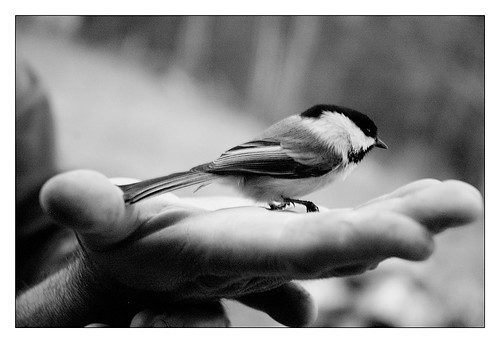
Bird in hand by jcandeli
It is always a great relief to discover someone who has also struggled with writing anxiety and has learned to thrive in spite of it. It's also a comfort to know that I'm not the only one plagued now and again by the strange terror of dying suddenly before I can fix things in my work-in-progress. Bird By Bird is very much a conversation between Ms. Lamott and her readers about the process and perseverance of the writing life with an electric sense of humor. Most of what she has to say I'd absorbed before in writing classes and workshops, but it was oh so good to read it again in her voice. "We are just going to take this bird by bird," she says (p 20), in other words step by step.
One ray of sunshine that she offers us is the concept of the "shitty first draft." In fact, it's not a concept - it's a fact. "All good writers write them. This is how they end up with good second drafts and terrific third drafts... I know some very great writers, writers you love who write beautifully and have made a great deal of money and not one of them sits down routinely feeling wildly enthusiastic and confident. (p 21)" I need to pin this to my board (or my forehead), because I have do have a wild tendency to fantasize about published writers and the apparent ease with which they "should" be working. But art isn't easy. It's really hard, and yet really good.
Perfectionism messes us up and keeps us from completing anything: "the voice of the oppressor, the enemy of the people. It will keep you cramped and insane your whole life, and it is the main obstacle between you and your shitty first draft" (p 28). Lamott emphasizes the beauty of sheer effort, perseverance, writing for the sake of the story, silencing the voices in our heads that tend to lead us off course. Trust your intuition - the creative, irrational part of you, she says, "but be careful: if your intuition says that your story sucks, make sure it's your intuition and not your mother. (113)"
We should be focused on story and conveying truth through our characters, getting to know them instead of forcing them to conform to some preset notion of what a story is. The thing is, we won't know what the story will be, what will happen unless we follow our instincts and continue unconsciously down the path of discovery. Ms. Lamott reminds us that we shouldn't write solely for publication, but to write to give something back to others, to let something out of ourselves. "I tell you, if what you have in mind is fame and fortune, publication is going to drive you crazy" (214.) In other words: aim for the joy of story, not publication.
The over all message from this book that I intercepted was that the rest of the world will think I'm crazy, but that's okay. It struck me that I should be writing a wider variety of things - bits and bobs, journals, bloggings, stories - persevering in them and pushing back the road blocks to enjoying the writing life. I do have days when sitting down to my awful first draft (or any draft, if we want to be honest) feels like climbing Mt. Everest in 4 inch heels with a broken toe. I'll just take a couple of deep breaths, put the nagging overly-rational voices aside and tackle the story - whatever it is - bird by bird. Thank you, Anne Lamott. If we should chance to meet sometime I will greet you with a big hug.
Subscribe to:
Posts (Atom)