Wednesday, February 5, 2014

Long Time No See!

It may seem quiet here on the blog, but it's been a busy, busy couple of months for me.  Ideas for posts occasionally circle my brain, only to be swept away by something more immediate or exciting.  But there's good news: the year is still fresh, and my energy is getting back to where it was.

Timeline of Events:

28 November - Thanksgiving
29 November - Jillian gets on a plane bound for the UK
30 November - Jillian and Michelle are reunited in Oxford and a ten-day visit begins.
30 November to 9 December - Jillian and Michelle spend time hanging out at coffee shops (particularly Cafe Nero at Blackwells) reacquainting ourselves with our old haunts, watching Chuck, Farscape, Haven & Doctor Who, going to pantos, taking walks, writing, Christmas shopping (the glorious Scriptum on Turl Street), taking cold medicine, etc.

Highlight, 6 December - Jillian goes to London by herself as she unwittingly gave Michelle a cold.  Visited St. Paul's Cathedral and the Tower, navigating the London Underground solo.  Not a small feat for one born and raised in a Midwestern state that has no subway system.

9 & 10 December - the weary traveler makes it back to Nebraska and drives from Omaha back to Lincoln.
11 December - Jillian's car battery decides it doesn't like the frigid weather and promptly dies in the driveway.

Highlight - Jillian starts looking for a new apartment for herself and Ninja the cat.

25 December - Christmas.
6 January 2014 - Jillian finds a lovely little place with a view of Nebraska's capital. 
18 - 21 January - Jillian and Ninja move house.  Ninja puts up a fight characteristic of, well, a highly skilled ninja.  

Since then, it's been a matter of unpacking, rearranging, realizing what kitchen utensils I need, what furniture is still in limbo, getting a cat to adapt to new surroundings without a basement to throw her into.  All the while I've been painfully aware that I've not sent queries out for my novel in a long time, and that I need to get that particular wheel moving again.  

Perhaps it's just taken this long to regain my strength, my mental resolve, and keep at bay all of those doubts and devil voices that like to me that querying is useless, that my novel is crap, that I don't have a strong presence online anyway so why bother.  When you're anxious person, this is the reality, and it's just not helpful.  It drives you away from your everyday writing, the heart-stories and creative activities that define your day, your sense of self.  I don't want to give it up or shrink away so easily this year.

I want this year to be about forging ahead and hesitating less.  Call it a resolution if you will - or perhaps solemn goal is a better term.  Whatever it is, querying is one of those stages in the life of a book that can't be bypassed or jumped over or TARDIS-ed into oblivion.  No, the Doctor isn't going to pull me out of this one.  I have to do it myself.  

So I sent three queries this morning.  At the very least, I hope I'm continuing to learn something about this process, to think of this as a project and an opportunity and a leap of faith.  I am simply starting down the corridor again, and knocking on the doors.  Some day one of them will open.


open doors by kuronakko

Tuesday, December 24, 2013

A Spritz Christmas

When I was little, I came into a cookie tradition.  My parents were critical care and intensive care nurses who balanced their schedules so that someone was always home with their little girls.  Cookie-making was a way for keeping us busy.  And Christmas, of course, is the Season for Cookies. 


Every family has its special staple cookie - the one that has to be made each year in the same fashion because it won't be made at any other time of the year.  Cookies were an escape, a wonderful, creative distraction from the terrible weather, wet or dry, that characterizes Nebraska's bleak winters, mid- and late.  Without cookies, I somehow believed, Christmas wouldn't really come.

We made spritz cookies and almond bark-pretzel-m&ms cookies. The latter isn't really a cookie, but they were special.  Circle pretzels, with almond bark poured in and red and green M&Ms in the middle.  Before I was old enough to melt the almond bark myself, I remember watching Mom or Dad pour it into pretzels - there was something magic in watching the white sugary stuff fall from the spoon - pure liquid white.  As a child with a particular penchant for all things sugar and chocolate, this was a beautiful ceremony.  Still is, actually.

We did not make sugar cookies often.  I know we had the cookie cutters - stars and Santa Claus and Christmas trees - but they sat in a jumble in the kitchen drawer while Mom got out the old spritz cookie press and made a dough of flour and sugar and butter (three sticks), vanilla and almond extract: the aroma of the season.  I still have the old press.  Most of the parts are metal, and the thing is most likely twenty-five years old or older.  It's finicky, and falls apart easily.  I have a brand new plastic press that works like a dream, the latest in cookie press technology, but... 

"Haven't you thrown that old thing out yet?" Mom will probably ask when I visit for Christmas.  Well, no.  So much of my childhood is wrapped around this device, so many hours of watching her labor over a cookie sheet, pulling deformed blobs of proto-cookie off the sheet and begrudgingly throwing it back into the dough bowl.  She'd work until the pan was full of trees and stars and wreaths. Then my sister and I would descend with the colored sugar and the red-hots.  The old press doesn't make the cookies easy, but it did make it Christmas.  In the days when I imagined Santa dropping into our mantle-less house (we did have a chimney, but no fireplace), we always made sure there were spritz cookies waiting for him.


The don't make them like they used to.  
 
I'm thinking that this box might make an awesome handmade cover for a cook book.


 Mom eventually stopped making the spritz cookies.  You can't really blame her.  They're difficult to make and time consuming.  They're mostly butter and sugar, and are small enough that a handful are eaten at a time - the antithesis of a healthy diet.  But.  It's Christmas.

The spritz cookies would always ALWAYS go into the same blue tin.  Every year.  My parents tried to get rid of it years ago, but I took it with me because... well, my mouth waters and I sniff for that almond extract and vanilla smell every time I lay eyes on it.  Rest assured it has been washed several times since the '90s, but it is still "the" tin.  I was a kid listening to Grampy's Christmas tape, Julie Andrews was singing "Jingle Bells", and there was spritz cookie dough in my mouth (ah, the BEST dough EVER) and imagining the horse was really pulling that sleigh all the way around the tin.


What I appreciate about the cookies now is how easy they are to freeze and to give as gifts.  They go great with tea.  They're pretty and colorful without a thick smothering of icing.  They're bite sized (in some cases).  They smell heavenly.  Even as I make them now, I feel like that little kid aching for a taste of the dough, eager to mold it in my hands.  There is nothing quite like spritz cookie dough getting soft and buttery between in the fingers.  And as a writer, I find I need to cookie - do something purely tactile and savory - to get my brain working.  Kneading bread dough, chopping potatoes, simmering wine, decorating cookies so that they look like snowflakes - it all creates room in the brain for those stories to grow, to simmer.

The best Christmas gifts involve food and drink and sharing it with others.  Back in September I thought I should write stories and give them to people this Christmas.  That didn't happen.  Little stories aren't easy for me, and with the double stress of a trip to England in the first part of the month and a move sometime in the near future I turned to the simpler plan of cookies and puddings.  I'm glad I did.  These treats help us face the long dark of another winter of resolutions failed and met, of more snow and shivering and dying car batteries.

This winter I'll be back to getting those query letters out to potential agents.  I'll be looking for my first solo apartment.  I'll be writing a sequel to my novel and dabbling in the revamp of another.  I'll also have a few spritz with my tea, while my supply lasts.

And who knows?  I might make more for St Valentine's Day.


Wednesday, October 30, 2013

Real Ghost Stories

This summer I was told a ghoulish story after dark in an old Civil War-era cemetery.  

A group of friends and I had spent the afternoon out in the country in our friend Neal's uncle's pasture in south central Nebraska shooting pistols, shot guns and scope-rifles.  This was a new experience for many of us city folks.  We'd climbed into the back of Neal's pick-up - some of us hanging on in the back - and he took us over hills and ruts and around grazing, jaded cows to the place where he'd set up targets.  We plugged our ears, shot at Diet Coke cans with a scope-rifle, hit clay pigeons with a shot gun and generally had a good time as the sun went down and the full moon showed its face.

Neal told us the pasture we were shooting in was not far from the site of an Indian battlefield.  It turned out to be the prelude to the night's next activity.  He took us over dirt roads and onto a path that meandered down through and behind a corn field.  At the end of this road was the Farmers' Valley Cemetery - complete with the Nebraska marker - tucked away out of sight. 

I took this photo as we left.  It was about 11 or midnight. 

Among the graves were Civil War veterans and their families, some of the first settlers of in that area, children who had died young in skirmishes with the Sioux.  It was the quintessential prairie graveyard, small and understated, rich in history.  We walked around with flashlights, looking for names of the veterans, amazed that the stones were still legible even after 150 years.  Then, as the night breeze picked up and got chilly, Neal told us a chilling tale.

He and his brothers had been staying in a cabin not far from where we were standing one night several years ago when they heard the sound of hammering and incantations. Needless to say, they lay in terror that night.  The next morning, one of the flat stone-slab graves had been broken into and the body removed.  Later on, a group of satanists were arrested in connection to the theft.  Neal told us with a deadly-serious expression that these satanists had planned to smoke the bones.  When we saw the grave, the stone shards were patched, but the evidence of their task remained.  A chill traveled down my spine.  Something rustled far off in the trees,  or perhaps in the corn field.  My spine tingled.  We all shivered. 

It was hard to tell with Neal's expression if he was kidding us, or if he'd invited friends along to scare the living daylights out of us.  We saw no ghouls, living or otherwise, but I know I felt something... some awareness of the past that hadn't been there before.  The dark deeds of others can mark a place in ineffable ways.

I kept thinking about the story of the theft of bones and how the real mysteries of this world are the living ones. 

In August, just weeks after the group of us had been there, an eighteen year old was arrested for vandalizing over 50 tombstones in Farmers' Valley.  He was charged with criminal mischief, and the local community rallied together in September to begin repairing the damage.  A Journal Star article conveys the sense of loss this act created; the cemetery is history, personal history, and it must be guarded and cared for and visited.  I am so glad I saw it when I did.

I've found the Farmers' Valley Cemetery on Rootsweb, which tells the story of Marion Littlefield's death in battle with the Sioux, the arrival of Scottish settlers to the area, and the hard lives that were lived out here.  This little slice of history is just south west of Henderson, Nebraska in Hamilton Co.  Oh, the stories this ground can tell.

Wednesday, October 23, 2013

"I should be" Versus "I am"

Write and forget the rest of the world.
"Write and forget the rest of the world" by Mary Grace Ardiente de Castro on flickr

I often find myself plagued by the ubiquitous word "should." This author does this, therefore, I should be doing that, or I must do that.  The work clicks in when I measure myself against the success of other authors: failing to make a thousand or more words on a page, not getting anywhere with agents, not having time for my online writing community.  For whatever reason, negative messages pop up in brain like weeds and choke out all the good beautiful foliage that should be there:

- "I should have been trying to get pieces published in high school."
- "I should be getting up at 5 a.m. to write and fulfill a word quota for the day."
- "I should have been done with that story by now."
- "I should write this one story because it seems marketable."
- "I should be blogging at least once a week, in a witty and engaging manner using lots of graphics, video and subliminal messaging."
- "I should be tweeting and posting on Facebook and commenting in articulate paragraphs on other blogs and writing reviews on Goodreads and making social connections and...."
- "I should have more to show for my writing career."
- "I should go to that one writing conference because all the other up-and-coming writers are going, getting advice, getting agents."
- "I should be an extrovert."
- "I should be able to write anywhere and everywhere, even with a jackhammer right outside the office window."
- "I am doing this all wrong."

None of these are necessarily true, although it is strange how much we believe them.  And when, say, I physically cannot get myself out of bed at 5:00 to write, the whole day is ruined before it starts.  "I'm a bad writer!  I can't get my act together!  I'm not disciplined!  I only wrote one whole sentence today!"  And what of these fantasy writers who are getting agented all over the place?  Is this really true?  Is it really that easy?  Or is it just part of the negative static clogging our creative minds, keeping us forever in the past?

So we're not like that hypothetical group of successful, smiling, rich, creative, brilliant people. They are an illusion.  No one has an easy writing life.  Writing is freaking hard.  Period.  Writers come on a vast spectrum of disciplines and habits and quirks.  You may not be able to function at the writing desk without a shot of whisky, or maybe you need complete silence.  Some write in bed.  Others on the subway.  Some can write in little snatches on the go, others need to stick close to home base.   Or if you're Dan Brown, you need to hang upside down to get the creative juices flowing.  Where you fall on the spectrum of discipline and a quota of words is part of you. 

The point is we should be focused not on the writers we think we should be, but on the writers we already are and what we're accomplishing now

I'd thought the whole scenario of getting up early and getting work done made perfect sense.  And it did for a few days.  It did feel awesome to be up at 5:30 and writing away, but the weekends came, I'd sleep in and it turned out to be a very difficult routine to maintain.  I'd panic - there was no time or mental space to tinkering with my WIP at work (jackhammer noises coming from the elevator shaft - there is no quiet way to disassemble and replace an elevator) and by the time I'd get home, I'd be too beat to do anything creative.  Coming home at night is the bookend of the day - things are winding down, kitty needs to be fed, the trash taken out, my dinner made, the dishes washed, the shower taken.  So I've been spending time at a coffee shop not far from work for an hour to two afterwards.  I have found more enjoyment working there at my own pace, without the constraints of time than when I was forcing myself out of bed at an ungodly hour.  Who knew?

I haven't been measuring word counts, either, because I feel - especially with a tentative draft - it is a great way to perpetuate loads upon loads of meandering Nothing.  I cringe at the idea of National Novel Writing Month, of having to spit out 1,667 per day with little room for thoughtful brainstorming or rest.  But that's okay. Many people enjoy the exhilaration of diving right in, to "get 'er done!" as the great Nebraska philosopher Larry the Cable Guy says.  It just doesn't work for me.  There are times when quantity cannot replace quality. 

Personally, I feel like I've spent a great deal of time trying to imitate those visibly successful writers, join bandwagons and get swept up for a spell in a particular creative zeitgeist. I joined Twitter only to panic that no one was paying attention to me and that I couldn't write a 143 character tweet to save my life.  Nor did I have the energy to dance across the internet leaving an electronic trail of comments, shouting "I'm out here!  Pay attention to me!"  I hated myself for trying. 

There is no magic formula for success, particularly success in writing.  No set time frame.  No standard career plan.  And yet we still believe that if we hang upside down just like good ol' Mr. Brown, we might be just as successful - a wide readership, bestsellers, movies, mansions.  If we're smart or well-read enough we might get the Man Booker Prize like 28 year old New Zealander Eleanor Catton did this month.  And... if we don't we tend to think, "hey, I'm 28. I must have missed the mark and my big break.  My life is forfeit."  Bah.

The things we tell ourselves.

Of course, there isn't anything wrong with social media, with conferences, with challenging yourself, but in the day to day, while we're in-progress and still working full-time jobs, it is so much better to focus on the gifts and the circumstances we were given to continue on with our work.  To write because we're compelled and made to write, not to conquer everything in one day or judge the whole of one's budding career by a string of bad days or where others tell us we should be.  If we're trying our best to hone our craft and navigate the publishing world, that's success.  Success might take years and years.  It doesn't matter what it looks like to anyone else.

I return to Anne Lamott's advice about the one-inch picture frame: tiny assignments - write one description, one little sentence and see where it takes us.   And from there, just write moment by moment.  Focus on what can be done today, or this hour, or until the baby wakes up from his nap, not what "should" be done in a week or even a month.  Otherwise, writing becomes the ultimate in Sisyphean feats. We must follow a string, a stepping-stone path of little goals - keeping the future in mind but not comparing goals to others' achievements.  We're not "there" yet, but we will be.  When we do get there, it will look worlds different than how we imagined it.  Our job for now is simply to hang in there.  How you "hang" is completely your choice - not Dan Brown's, Stephen King's, Margaret Atwood's or Charles Dickens'. 

So.  Enjoy the ride.  Spread your wings at your own pace, exercise them everyday, practice flying further and further toward that horizon.  You'll get where you need to be soon.

Tuesday, October 1, 2013

A Study in Micro-Reviewing

I've been batting around a notion for a while that seems rather, well, obvious.  I frequent the library often, and try to read a great variety of works both within "my" genre and outside of it, and yet I find myself in the habit of not sitting down and putting into words what I did (or didn't) take away from it. I have no excuse.  It is important to be able to articulate why I love or loathe a certain book - not just as a writer but as a thoughtful reader.  Besides, it's just good practice.  We opinions, fellow readers!  We need to voice them!

I'm not a literary critic.  In fact, I think a great deal of us cringe at the word.  The one class from which I had to withdraw in college was a Critical Theory class in which the lecturer's unforgiving attitude toward those of an writer's mindset gave me a nasty panic attack.  So... I'm not a critic, just a reader and a writer looking at the story and what it said to me.  I realize it doesn't have to be an article.  It doesn't have to be a polished essay.  It doesn't need to be more than say, 250-300 words.  The length of those pesky query letters... and no doubt easier to write.  Ahem, here goes.

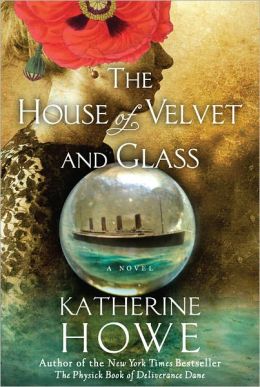
 The first book in this Micro-Review series is The House of Velvet and Glass by Katherine Howe.  Published in the spring of 2012, it is the second novel Ms. Howe has presented to the world.  The first was The Physick Book of Deliverance Dane, an intriguing novel spanning modern-day Harvard back to the Salem witch trials.  I read The House of Velvet and Glass because Deliverance Dane struck such a nice balance between historical fiction, contemporary coastal Massachusetts and a hint of magic woven throughout.  Her characters were genuine and driven to uncover the mysteries presented them.  Her descriptions were vivid - I particularly liked her description of the dilapidated house to which the main character returns and the mushrooms growing at the foot of the stairs.  The novel was warm with hints of good witches, a magic inheritance from mothers to daughters and long-lost diaries, an October story.

The House of Velvet and Glass also takes place in Boston - this time in 1915 after the Titanic disaster.  As Deliverance Dane was a story about witches and magic, Velvet and Glass is about sinking ships, opium dens and crystal balls.  I did not find it to be as "entrancing" as the jacket blurb says.  The main character Sibyl Allston is a spinster at twenty-seven, still suffering from the rejection of a suitor long ago and the deaths of her mother and sister on the Titanic.  Her brother has been expelled from Harvard for cavorting with an actress.  Her father is an old grizzled seafarer with a blue parrot.  Katherine Howe, it must be said is a consummate researcher.  To read Velvet and Glass is to transport yourself into the textures and the trappings of medium parlors, Back Bay mansions and opium smoke.  The surroundings are vivid... but perhaps too vivid because they tend to drown the characters out to types - they're good characters with some but not great depth. 

I couldn't get close to the characters.  Sibyl discovers that using a scrying glass in conjunction with opium use gives her powerful visions; her old flame - a psychologist - tries to protect her from it; her father battles his own addictions for similar reasons.  Sibyl strikes me as being a little too naive, while also being stubborn, which is irritating.  Her brother of course falls in love with a woman of indeterminate class.  Other rich ladies are snobbish.  It's 1915 and Sibyl doesn't know that the laudanum her father takes is an opiate and therefore addictive?  And - no doubt because I've watched Downton Abbey - I saw the story line of the Titanic connecting to the Great War almost immediately.  It was so predictable - although I cannot rule out the idea that this was somehow intentional - and the characters helpless to do much to change their fate... even if they can see the future.  I expected different, more dynamic choices on Sibyl's part.

I wonder if this is an example of Second Novel Syndrome, my term.  Having made a successful debut, the author is now under deadline for the second bestseller - continuing a brand of story.  Perhaps there isn't as much freedom to create and explore in this new novel; publishers and editors want a working outline, a synopsis of a novel that is still in the infant stages.  In order to meet deadline, the author must work to the outline.  I'm not saying this is true of Ms. Howe's experience, as I'm not in a position to ask her, but it is the sense I gather: to produce something fresh and in the same vein as Deliverance Dane but on a schedule. 

That said, The House of Velvet and Glass is a thoughtful and scholarly book.  Katherine Howe has painted a vivid picture of 1915 Boston - showing us how the mediums (charlatans) turned their tables, what the scientific minds at Harvard thought about visions of the future, and the inheritance of addiction.  There are beautiful moments and graces, fiery kisses and apparitions, a dance in the ballroom of a sinking ship.  Despite its flaws, it is a beautiful book.  It is not an epic but a slice of life, and it doesn't have to be more than that.

This review is actually about 500 words.  See what happens when you start small? 

Welcome

to a blog by three people who write, for anyone else who wants to write. It's a cruel world for creators, and here we promise support, whimsy, and curiosity that will hopefully keep your pen moving and keyboard tapping!

To read more about why Daedalus Notes exists, click
here.