Dreams and visions are part of the ineffable human experience - the voice of our subconscious working through problems, presenting us with improbable but not impossible challenges, worst-case scenarios. They reveal our anxieties, force us to confront them in our waking lives. A life line. The red cord we follow through the Minotaur's labyrinth. Naturally, they find their way into our stories as that nebulous, unexplained but felt stuff. Scientists still cannot fully explain the function of these workings of the subconscious, but deep down we already know what dreams are saying to us, how they're guiding us, and that we'll follow.
It can be argued that dreams and visions are an overused device in writing and films - a short cut out of a plot tangle or tacked onto the end of a story as a sort of apology for the improbably of a scenario. Dorothy wakes up in her own bed surrounded by her family, as if they'd been there the entire time, as if Oz didn't exist.
Twilight: Breaking Dawn Part 2
 |
| Twilight Breaking Dawn: worse case scenario. |
You've heard my opinion that films and stories as a general rule are different animals. They have to show things in different ways: images versus words. The narrative of the book is no longer first person but completely, intimately and cosmically omniscient.
The last film of the Twilight series deviated from the book one particular note. Bella is newly a vampire, and Bella and Edward's daughter has caught the attention of the malignant Volturi coven who have come to destroy their family. In the book, the confrontation between the Cullens and their friends and the Volturi is little more than a trial and testimonials in the snow, wrought with tensions that are eased only by frank discussions, and Bella's preparedness to protect everyone she can. The book preps us for a battle that never comes. The film, on the other hand, shows us the battle that would have been: a battle begins with the beheading of Carlisle Cullen.
Gasps in the theatre. The battle sequence was intense, the body count high with Carlisle, Jasper and others among them. Only at the end, when Edward and Bella successfully tear Volturi leader Aro's head from his shoulders do we realize that this entire battle has taken place in Alice Cullen's head and Aro has seen it all. Of course! Perfect sense! I thought; Alice has the ability to see the future, and Aro is a mind reader. We breathe out our relief as we realize that Carlisle and Jasper are still alive, that Edward and Bella's daughter is safe and that the Volturi have no reason to stay. For now.
I can see why there would be skepticism about this vision. It does seem to lean toward a cheap gag, a way to fill in the action-vacuum left by the novel, and play Gotcha! with the filmgoers. The temptation is to say "that entire sequence was a LIE!" But... it worked for me... because this dream-battle was already a possibility, and most certainly experienced. Sometimes you need to see the train wreck in order to prevent it from happening. Did it happen? No. Does it matter? Yes: it's all the better for having not happened. Is it a lie? Nope.
Doctor Who
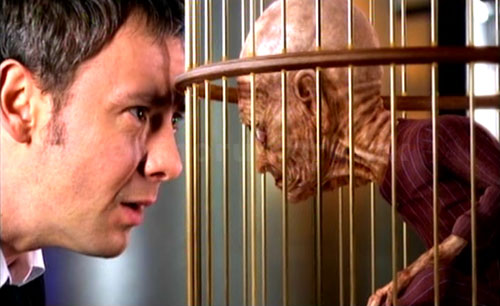 |
| Worse case scenario: the Doctor in the Master's birdcage. |
Doctor Who uses this quite frequently. Series Three saw the world taken over by the Master who opens a paradox to the end of the universe, tortures the Doctor and imprisons him in a bird cage. Martha turns the Master's psychic network against himself and time reverses back a year - back before the world completely fell apart. Only those standing at the "eye of the storm", on the ship where the Master launched his evil plans, remember what they'd gone through. The world is none the wiser. Did it happen then if time reversed itself? Just ask the Doctor, Martha and Captain Jack.
Life on Mars (UK)
 |
| Sam Tyler: Am I mad, in a coma, or have I traveled in time? |
Another example - and possible SPOILER ALERT for those of you haven't seen it and want to see experience it spoiler free - involves the UK television show
Life on Mars (which ended in 2005). The question driving the series was whether Sam Tyler, a detective inspector who wakes up inexplicably in 1973 Manchester, is dead, in a coma or has actually traveled in time. The writers do an excellent job of keeping us guessing and speculating. Don't read the next paragraph if you're in the midst of a first-time viewing.
We come to learn that Sam's experiences in 1973 are (supposedly) the result of a brain tumor, and that his final challenges gear him toward a successful surgery and finally waking up. When he does, he finds the "real" world colorless and lonely. Sam, longing for the friendships and the hirsute situations of 1973, jumps off of a building, essentially committing suicide in order to return. He does return to 1973 as if nothing had happened, to tie up loose ends, (finally) kiss the girl and drive off into the sunset. Is the glimpse of happiness a lie? Well... I thought of it as Sam returning to the world that was most real to him. Crossing the threshold does signify a death, but not of Sam. Instead, it is the death of what he has always believed is reality. Sam's tumor-coma-dream pointed him back to the dream itself, asking us the question: what is our reality?
The X-Files: "Dreamland"; Harry Potter
 |
| Mulder as Morris Fletcher. |
There's another example - neither vision nor dream, but reality gone completely upside down. In Season 6 of The X-Files, Mulder switches bodies with the despicable lie-mongerer Morris Fletcher due to a time-displacement accident at Area 51. Mulder, looking like Fletcher, has to convince Scully of his true identity, while Fletcher, looking like Mulder, takes over Mulder's life, desperate to escape his own. In other words, the worst has happened (not so bad as the Master controlling the universe, but...). Mulder is without Scully and the X-Files, and no matter what he does, he cannot set it right. Fletcher, content in Mulder's shoes, ensures it stays that way. The situation - hilarious as it at times - is completely unsolvable until the time displacement errors (long story) reverse on their own. Life resumes and no one remembers, but there are hints that things did change: a penny and dime stuck together and the new furniture in Mulder's apartment. Did it happen? Yes. Do the characters need to know? No, but we need to know.
A function of dreams - particularly nightmares - is theorized to be how the brain works out worst-case scenarios, trains us and prepares us to face the anxieties that taunt and haunt us in our waking lives. Sometimes it's hammy and glitchy. Other times it is profound... while being forever baffling. Is it real? Is it not? Is it The Matrix or a different level of consciousness? If you've seen Christopher Nolan's Inception, you know how entire films can make us think about this long after our minds have been blown away in the theatre. We will never stop asking those questions. And that's a good thing!
In
Harry Potter and Deathly Hallows, you may remember that Harry, after facing Voldemort for the last time, finds himself in an empty train station with Dumbledore. Dumbledore is dead but conveying his wisdom to Harry from beyond the grave, answering what until now has been an uncertain question: will Harry live or die? Is this heaven or some sort of waiting room? Harry asks Dumbledore if seeing him in this empty place is a dream or if it is real. Dumbledore says that it is both. This has become one of my greatest fantasy-writing mantras.
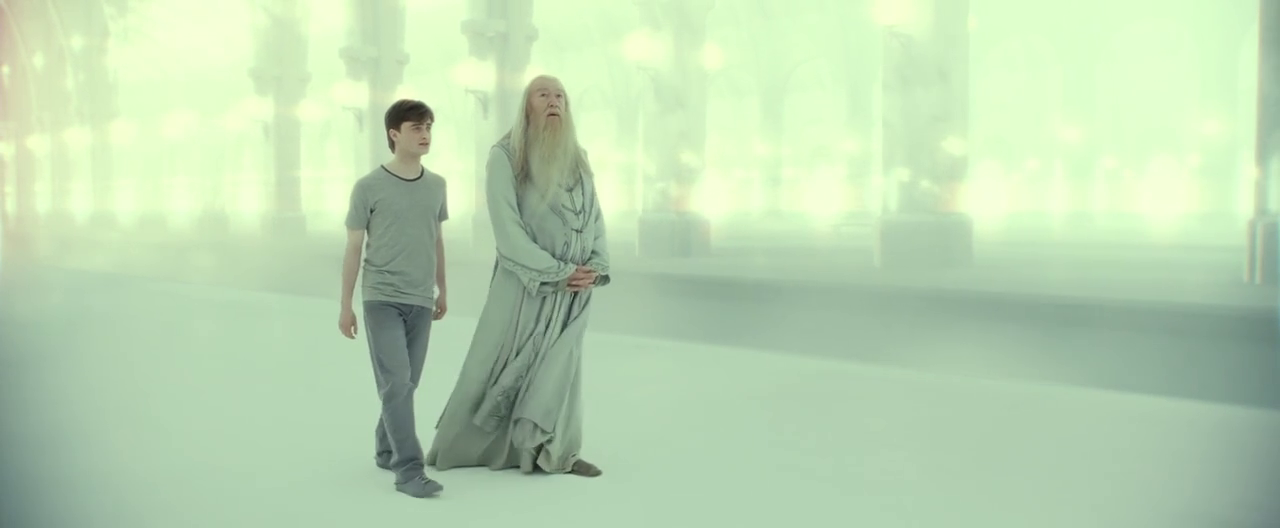 |
| Dumbledore: of course it's real. |
The magic of story telling is not to ask whether or not something TRULY happened, but what said event says about the characters, their possible limits, and how they fulfill and surpass our expectations. Dreams
are real, a crucial element of the human psyche. A dream sequence will fall flat if it fails to speak beyond "what if" and make us ask that question of our ourselves. Did it happen? What is reality, anyway? What does this say about that particular character, what he's capable of, where he's going, what he could never do? Those questions continue on, and make me want to write until my hands fall off.

