Wednesday, March 6, 2013

Folly

Adventures in Logophilia, Day 176:

folly

Folly is the lack of good sense, understanding or adequate foresight; an act of foolishness, or more specifically, a costly undertaking which results in embarrassing or ludicrous ruin.  This word is Middle English, which means it was borrowed from the Old French word folie, meaning "madness." (Oxford Dictionaries.)
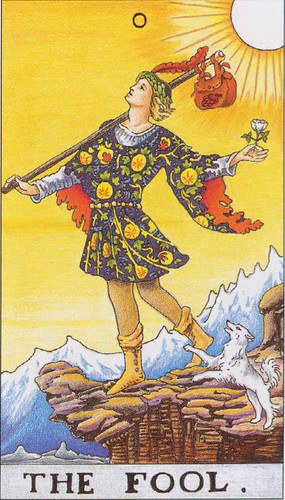
0 The Fool
The Fool, as seen on a tarot card, is about to fall step off the edge of a cliff.

I actually don't believe folly is all that bad - it is the state you start out in when embarking on a journey.  I've learned that I am still the fool when it comes to this trying-to-get-an-agent business.  The important thing is to realize that blunders will be made.  I will trip and fall several times.  I will have to go back and rewrite that one chapter I thought was perfect.  I will write stupid tweets and worry about what people are thinking, if anything at all.  Folly is a learning curve; I've learned that the Fool on the tarot card is represented as a perpetual youth... and aren't we all?  I don't mean perpetually young, but constantly learning.  How else can we learn but through trying and stumbling and getting scraped up... and picking ourselves up again?  

Embrace the fool.  He's really not that bad.  Or fatal.  Or stupid.  He just has convictions about things that haven't been (but need to be) tested.  He doesn't watch where he's going, but he'll soon learn his lesson.  I'd like to see him after he picks himself from tumbling off that cliff, dusting himself off, examining his bruises and looking up to see where he came from. "Well, that was dumb," he might say, "but I don't regret a moment of it."  

So... write like a fool to write better.  Laugh at yourself.  Move on.  Harbor no regrets.  I think I can handle that.

Hegemony

Adventures in Logophilia, Day 175:

hegemony

the over-arching influence or authority over others, domination. 

Monday, March 4, 2013

Elucubrate

Adventures in Logophilia, Day 174:

elucubrate

 oil lamp
by louveciennes

to express studious efforts, working (composing, studying, reading) by lamplight.  I suppose this might be where "burning the midnight oil" comes in.  Whether it's late at night or early in the morning, we all put this to practice because art is calling us.  And there is something about a single lamp (whether electric or flame-illumined) lit in the dark, quiet hours that promises peace. 

Sunday, March 3, 2013

Burgeon

Adventures in Logophilia, Day 173:

burgeon

to put forth fresh growth, or to grow vigorously, flourish.  

I think we're all about ready for Spring, aren't we?  In another sense, after a week of craziness at work and strange stomach issues on top of that, I am ready to get back into my writing soil and put down roots once again.

 Seedling growing out of log

I remember I saw this word on the cover description of a novel I read a lot as a kid.  I didn't know how to pronounce it, so I took it to my dad who say "maybe, bur-GOYN?" So for years, that was how I said it, perhaps incurring many a puzzled look.   I later realized that it rhymes with "surgeon," and was actually quite relieved.

Saturday, March 2, 2013

Intercalate

Adventures in Logophilia, Day 172:

intercalate

to insert a day into a calendar, or to insert between or among already existing layers or elements.  Every four years we intercalate February 29, otherwise known as Leap Day.

Day 60
Matt Preston

I've always had this strange fantasy of mixing up the months which contain 30 days with the those containing 31 days.  It would be an easy mistake to make, wouldn't it?  I don't know much about our calendar and why certain months were given a certain number of days to total out to 365 or 366.  I imagine that if we had to insert another day into our calendar to, say, balance out dramatic changes in time, adding days to November, February, April, June and September would be an easy change.  There's a science fiction story brewing here.  I just know it.  Dibs!

Friday, March 1, 2013

Tessera

Adventures in Logophilia, Day 171:

tessera

A tessera was a small tablet made of wood, clay or bone, which the Romans used as a ticket, tally-token, voucher or even a means of ID.  These came into play in The Hunger Games, as the number of tessera traded and bargained for by eligible candidates for the Games could mean the difference between surviving and starving under the rule of Panem.  It is just one of many Roman flavors Suzanne Collins gave her series. 

Thursday, February 28, 2013

Quincunx

Adventures in Logophilia, Day 170:

quincunx

an arrangement of five things in a square in a square or rectangle, one at each corner and one in the middle.  I always think of five pillars when this word comes up: four pillars holding up a structure at each of the distinct corners, the fifth secretly holding up the middle. 

FOUR208 - The quincunx
A series of quincunx from an ancient puzzle.

Welcome

to a blog by three people who write, for anyone else who wants to write. It's a cruel world for creators, and here we promise support, whimsy, and curiosity that will hopefully keep your pen moving and keyboard tapping!

To read more about why Daedalus Notes exists, click
here.