Thursday, July 18, 2013

In Defense of Shrinking Violets

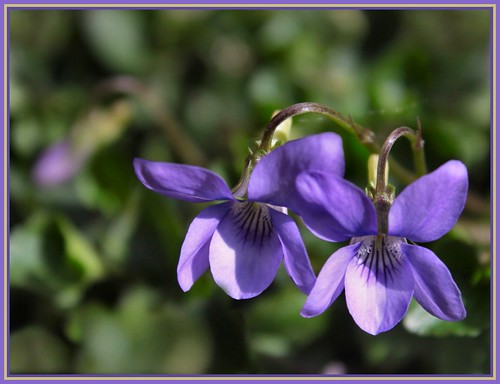
violet flowers
Violet Flowers by nondesigner59

I happen to like violets, violas and pansies.  They're sweet, unimposing, simple flowers.  Last year I found them growing all over the landscaping immediately in front of the house, seeded from violas I'd had on the front porch two summers before.  This spring I spied a third-generation patch growing in the middle of the lawn and took pains to rescue it from the lawnmower.  The original violas lasted from the end of May to October 2011. 

If properly cared for these can be hearty little plants, audaciously standing tall amidst a garden of bigger, bolder blooms. But they will shrink if they're not watered enough, or if it's too darned hot.  Or if a gardener decides that they are nothing but pretty weeds.  The phrase "shrinking violet" must come from this, and it's no surprise that I've seen it on writing blogs.  "This is no time to be a shrinking violet" someone wrote once in relation to "getting out there" in the publishing world, to relentlessly pursue agents and attend conferences, tweet like there's no tomorrow and blog until your fingers bleed.

I know it's meant to be taken lightly, but there are times when I resent this metaphor.  I cannot help but detect an implication that "shrinking" is cowardice or even laziness, a failure to act.  Simply, I am not and never have been a flashy person.  I cringe at the idea of crowds and loud places, and those things stress and tire me out easily.  It isn't quite fear, but the way I was made.  My energy simply cannot stretch that far, therefore, I've learned in the last few years how best to use the energy I have: writing my novels, steadily querying agents, slowing down on the things that tie my brain in knots. 

2nd generation violas, 2012.

I sympathize with the violet and the pansy, because I often feel that I'm a cluster of little insignificant flowers in a garden full of more impressive specimens. The snowdrop boldly pops up through the snow, wasting little time as spring comes on.  The poenies spread out their arms and legs and take up as much space as possible.  The poppies are red and rich.  The roses - oh, the roses! - open in their intricate splay of petals and smell like heaven, drawing the human eye towards it like a perfect sunset in the garden.  The clematis shows off its climbing skills.  The four-o'-clocks demonstrate their punctuality.  With marigolds, impatiens and cosmos, lilies and vines, flowering shrubs and bleeding hearts, the attention seems to be everywhere else.  Sometimes it seems downright Sisyphean to try to be anything other than what I am, a viola working a thriving quietly in my own special bit of earth. 

That does not mean that I'm shrinking.  Right now, I'm still waiting on agent responses to my recent batch of queries... and have received many "thanks-but-no-thanks" form letters.  If I was shrinking, I wouldn't be preparing to do it again in a few months time.  I keep reminding myself that an agent out there also likes violets; I simply haven't found him or her yet. 

I hope to be like the vagabond violas I find year after year in the garden and the lawn: shrinking down, but coming back time after time.

Monday, July 1, 2013

Meanwhiles

Words
Words by Daniel Smith

I've spent the last month diving back into the sequel of my novel.  In so doing, I've had little brain space for tweets and blogs - I'm sure you understand what that's like.  The nature of the sequel is/will be quite different from its predecessor, as well, and I've had to acquaint myself with a totally different narrative personality (male and intense, as opposed to female and a bit naive) and backstory.  It is an intricate process not only familiarizing myself with the new voice but building the vector, or plot line, on which the novel will be going.  It's like juggling.  Or trying to pat your head while rubbing your stomach.

The hard part isn't so much writing from the point of view of a man, mercurial and deeply wounded, but keeping the outside world (and my worry over my place in that world) decidedly OUT of my writing.  Reading Jeanne Kisacky's post on "What Not to Think About When Your Writing" on Writer Unboxed this weekend definitely helped me on that score: don't think about your life; don't think about the industry.  She says "the fastest way to end creativity and lose the tenuous hold you might have on the gorgeous will-o-the-wisp which is your perfectly told story: think about the state of the industry and how it is all crashing down (in some form or another) while you write."  Yup.  Been there.  Done that.  Not pretty. 

It is difficult to ignore the fact that my first novel is still on submission and that I'm still waiting for someone (anyone!) to request a partial manuscript.  (Come on!  Just one!  Please!  Do you ever get to the point where you think you're annoying God with all of your prayers?)  Logic would dictate - hey, should you be writing the sequel before the first novel is, you know, "out there"?  Logic is wrong.  Writing, in fact, has very little to do with logic or common sense or whatever it is.  The fact is, I've long come to terms with the fact that this story demands to be told: Dorian's story and Sive's story.  This is my vector, and I know it's right,  even if the outside world makes me want to "cry havoc" or curl up in a ball under my desk. 

The important thing is that I'm writing and learning how to handle this purgatorial agent search.  In a few years time, I'll look back on this as just part of my education.


Thursday, May 30, 2013

My Kingdom for a Flash Drive!

Circuit Board
Circuit Board by Fisherss Zhang

It seems that Spring is the time the of year for technological mayhem to come down on me.  Always.  I don't know if it is the tricksy hand of Fate or something less cosmic.  The laptop being the sole canvass on which I write my novels, this is always a big deal. 

2012: computer virus - vanquished with the proper dosage of anti-malware software.
2011: laptop fails to recognize power cord - BestBuy (grr!) sends laptop to Dell to fix.
2010: Jillian falls down the marble staircase at work, is fine but laptop is injured in the most expensive (warranty-won't-cover-it) way; the screen is spider-cracked.  Costs hundreds to repair.
2009: Old (5 year old) laptop acquires virus and Jillian buys the new Dell.

This year, aside from the typical wear-and-tear, unsightly scratched keys and dusty screen, the 4 year old Dell is healthy.  The casualties this year are two of the secondary gadgets that have become important to my creative life.  1.) My little green iPod nano (6th generation) died a sudden, unexplicable death after a year and a half of musical life.  It simply died in its sleep.  Baffling because I purchased the thing to replace my 7 year old iPod Classic, which for some reason STILL WORKS.  2.) The 4GB flash drive that I use to store the scanned files of my writings from the nascent childhood years through high school decided that it had no will to live, either.  Plugged into the computer, the laptop doesn't acknowledge its existence.  Neither does roommate's computer. 

These, in comparison to the laptop woes of yesteryear, are more inconveniences than crises.  The iPod can be repaired (for a fee) or replaced.  My music is safe.  The only thing I can't do is walk around with my creative mixes and transport myself into those inner worlds.  (The Olde iPodde only works from one earbud and has to be plugged in all the time.) Yes... there is that thing called silence I've discovered recently.  Nothing tickles the anxiety demons like listening to a lot of loud epic music (ahem, Two Steps from Hell).  Walking in silence allows me to take in the sounds of birds, of people talking, of the wind in the trees, thunder, planes, etc.  An internal, world-building brainstorm takes shape in a quiet(er) mind... on its own, without any help from soundtracks or symphonies.  Nothing clears the mind like quiet.  Nothing. 

The flashdrive is probably the bigger problem.  The day I discovered the 4GB's death, I spent way too much time trying to find solutions via Google.  The verdict is that the thing is dead, dead, dead.  Some tech-savvy people had suggestions for taking the drive apart to see if the elements in it were broken, and if they were, solder them back in place.  Even if I could take the thing apart, that seemed out of my range of skills.  Another idea: send the drive into a data recovery service for a couple hundred dollars and receive the files back on a disc.  Hm.  Not today. 

The bottom line on the flash drive problem is that this form of data storage is getting cheaper to obtain, therefore it's wearing out faster.  I had no idea about that.  All I cared about was that the flash drive could hold everything from my 1,000 page high school journals and much more and STILL fit in my hand.  For years, the flash drive has been the convenient alternative to the compact disc.  And now... learning that I should have had back-ups to these back-ups is news to me... that perhaps I was foolish to be scanning those files onto a flash drive instead of the harddrive in the first place, because all of my careful work is essentially gone.  All those writings, musings, prayers and projects - not to mention hours upon hours of scanning it all page by page - gone.  Almost.

Upset as I was, I didn't shout: "Cry havoc!  And unleash the dogs of war!" or "My kingdom for a flashdrive!"  I didn't beat my breast and roll in the ashes.  I took a hard look at these things I'd held so precious for so many years, scanned to PDFs and finally shredded.  Why did I shred those things?  Those papers and letters and journal entries and poems? These same things that took up most of the space in my backpack in high school?  I shredded them to make space for other things on the shelf, to be more organized.  I scanned them as an act of preservation, to remind myself where I started in this writing life.  But... I did not scan them to tell me where I was going.  In all honesty, I hadn't touched the 4GB in months.  If not for the residual pile of papers I wanted to scan, I would have forgotten it was there. 

All of this has me thinking about our reliance on technology... from e-readers to iPads to data clouds.  Nothing lasts forever.  I remember that my parents decided to assemble items for a time capsule around the time of the millennium.  I had a brilliant idea: record audio tapes (the favorite creative medium of my sister and me) of the four of us to carry messages into the future.  No, my dad said, it won't work; the batteries and the magnets will have worn out by then.  Or the technology will be so changed no one will know what an audio cassette is when they pluck it out of the box, just a hunk of plastic with a not-so magnetized ribbon and some holes. 

In this world, technology is obsolete the moment you buy it.  In a few years, when your MP3 player fails or your laptop bites the dust or your phone "needs" new apps, you'll wind up buying a new one, the next bigger-and-better thing.  Nothing we make will ever be completely permanent or backed up.  What about the pyramids, you ask?  Well, even those can crumble into dust.  Nineveh, anyone?  Whole cities and civilizations have been lost to the devestation of time.  Whole libraries have burned.  A number of Shakespeare's plays were lost.  This is not going to change simply because we have "better" technology - portable data drives and that nebulous thing called a data cloud.  These things break.  Data clouds, as I understand it, are expensive to maintain.  What about hacking?  And server glitches?  What happens if everybody saves everything to these clouds - pictures, videos, journals, recipes, stock market numbers - and the clouds keep growing?  Can the clouds hold it all?  Or will they burst and come raining down?  (And... there is an idea for a sci-fi story.)

This isn't a campaign for writing everything on paper and throwing one's laptop or computer tablet out the window.  I'm all for technology - old and new.  This is why I get excited about typewriters and calligraphy, old stand-by technologies that may be out of style in some spheres, but are definitely alive.  Perhaps I've read too much dystopian fiction lately (i.e. The Stand by Stephen King and The Passage by Justin Cronin), but I can't help finding the thought of typewriters and pens and paper comforting... something to fall back on if or when the lights go out.  Ah, technology - the tools change but the goal is the same: create something new.

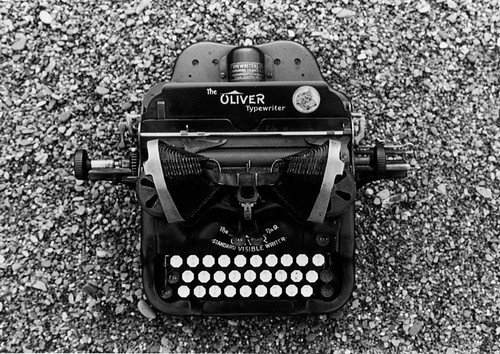
typewriter.jpg
Old Typewriter by Peter Gray

If time passes and I learn that the files on my flash drive are irretrievable, it will be a sad day indeed.  But... I have what I need to write forward.  If my iPod cannot be revived, I'll purchase a new one.  Not all is lost.  What's important cannot be down- or uploaded, saved to multiple devices, locked in a safe.  It's inside: that passion to create something new.  And sometimes, frankly, we have to make room for those new things. 

And I'm okay with that.  Are you?

Monday, May 13, 2013

Creative Cartography

When I was a little girl, the first fictional map that took hold of my imagination was that of Neverland on the inside covers of my Peter Pan book.  All of the illustrations in that book are beautiful oil paintings - full of color and life from the veins in Tinkerbell's wings to the curl of Captain Hook's moustache.  The map, too, was created on the same medium and brought to life an island of coves and mountains, Indian camps and homes underground.  Here was Neverland in full relief, suddenly a real place.  Of course it was real.

I suppose it was no coincidence that maps began to show up in my writing.  From middle school into high school I spent a lot of time on that rudimentry program known as "Paint" in order to create the island-continents of the planet where my characters were from... ironically "Eiresta."  Once I painstakingly traced the contours of Ireland and England onto tissue paper and broke them up into smaller islands to form those continents.  Silly?  Maybe, but at the time I felt it was important.  I needed to map what I was seeing in my head, to make tangible the little backstories that were a heritage for my pseudo-quasi Celtic creations. 

In high school I lived, read, breathed, ate and dreamed Star Wars, which means that my little creative writing projects inevitably took that shape.  Inspired further by J.R.R. Tolkein's maps of Middle Earth, the map-obsession continued.  Imagine my delight when I discovered galactic maps of the Star Wars universe inside the novels I read.  Finally, I knew where Tatooine and Dagobah were in relation to Coruscant (or the Imperial City) and Alderaan!  This map was handwritten, imaginative, pretty.  It did not attempt to calculate light-years or the three-dimension distance each star had to one another.  It was art, not science - simple and beautiful.  Naturally, I had to add a few worlds into the mix:


My addendums are fairly obvious: they are written neatly on little scraps of paper and pasted carefully onto the map, tucked into corners between stars and across the spine of the page.  At the top right was Ceilte, Nabbeor and the starless Rift which served as a no-man's land between peaceful worlds and evil Euronia (which even the Empire was keen to avoid).  I could see it: pieces of the massive puzzle finally in place.

Years after leaving the Star Wars galaxy, I found myself writing a novel which took place much closer to home in North Yorkshire, Great Britain.  While I did, of course, study maps of northern England, I mapped something that came directly out of my writing - a piece of the moors that was entirely my own fairy land.  I created it because my characters drew it themselves, tracking their own footsteps through a childhood playground, through barrows that were supposed to be haunted, passed ruined abbeys to a mysterious coil of rock they called Adrian's Pass after a legendary monk.


I drew this by hand, and it was such fun imagining the terrain, the twists and turns and slopes my characters had to traverse.  Bleak Point was a memorial to people who had disappeared on Adrian's Moor.  Where the ridges begin to grow, the fog thickens giving way to visions of demons who look like Benedictine monks.  Rose Cottage (added later) was a dilapidated house the characters found and made into getaway accessible only on foot. 

Which brings us back to space.  Waterwill and its in-development sequel have their earliest roots in that old Star Wars project of mine.  Nowadays these stars (if they existed, that is) might be visible from Earth.  I'm envisioning a cosmopolis over five hundred years in the future where humans have expanded their horizons to other worlds.  A cosmopolitan "nexus" has formed around a new star, 61 Virginis.  It is called the Virgo Nexus because of this capitol.  It is almost twenty-eight light-years away from where the worlds around good ol' Sol (our Sun) continue to thrive.  Below are two maps-in-progress.  Though Waterwill is complete, I have gone back to reevaluate the (very) approximate distances between the stars and expand on the worlds between Virgo and Sol for the sequel.  I am finding this extremely frustrating.


This map contains a few "familiar" stars: Alpha Centauri, Altair, Vega, Arcturus, Sirius, Epsilon Eridani, Tau Ceti, Denebola, 55 Cancri, Castor, Pollux and Formalhaut.   I am trying to combine the fictional elements with the real stars, creating a sort of bridge between our home (Sol) and the Virgo Nexus.  The map above is supposed to be a "side-view"; the map below an "above view."


Like I said, this is a work in progress.  I've been working from several "star maps" from the internet, some helpful, some confusing.  I realized I am doing something here that I've never attempted before: that merging of fact with fiction.  The problem with these maps is that they represent two-dimensional thinking instead of three.  For example, Epsilon Eridani might be ten light-years from Sol or Earth, but it's at a diagonal away and below instead of simply ten light-years to the right.  On a 2D map, this diagonal would not properly register the distance... unless I got fancy with dotted lines and angles.  Last week, while I was away from the blog, I was busy pulling my hair out over the difficulty of showing distances as well as depths.  I was afraid of what mathematically-inclined people would say... how astronomers might snort at my imaginative calculations... how other science-fiction writers must have an easier (if not smarter) time of it than I do.

And then I realized "Hey!  This supposed to be art, not science!" Why did Star Wars appeal to me so much in the first place?  Because it wasn't concerned with the mind-twisting principles of relativity or a tangible explantion of hyperspace... or how the heck they actually have the capability of flying clear across a galaxy in a week's time (or less).  In Star Wars, these things simply were; no explanation necessary or required.  While my novels take place in Sol's interstellar backyard (or is it front yard?), and require a little more explanation as to how the vast distance is/was conquered by humanity, I simply see no reason to worry about whether or not Vega and Formalhaut are actually in their correct positions.  What matters is that they are part of the picture, part of that corridor between Virgo and home. 

And that's what I hope the maps, in whatever state of evolution, can show: pieces of the puzzle coming together to create a tangible world.  Everything else is just details: time, relativity, hyperspace. 

Tuesday, May 7, 2013

Cosmic Inspiration

I have been organizing my "Cosmic Notes" this week to refresh my memory on stars and planets and black holes.  For a non-scientist and one who is notoriously mathematically challenged, this is actually quite an interesting project.  I've begun studying maps of the closest neighboring stars to our solar system and envisioning a map between our "neighborhood" and the star systems that create the backdrop and setting for my novel(s). 

Everytime I go back "into" space I am fascinated by the possibilities.  This time around I'm learning about the habitable zone (the distance from a star that is neither too hot nor too cold, like Earth), the Heliopause, binary stars and pulsars.  More on these and other delightful things later this week.  For now, I wanted to share with you a link to Robert Krulwich's blog on the NPR site.  By some mad coincidence, he and I have both noted something very strange about the formation of our solar system. Compared to other systems under study, ours is quite atypical - our planets don't line up like those of other stars, we only have one sun, etc.  It makes me think of our knowledge of the universe is still quite limited, still Earth-centric, and still has room to grow.  Space is so weird.  Here's the link.   

Also, here's an interactive video called 100,000 Stars, a sweeping demonstration of our solar system, its star-neighbors and where we are located in the Milky Way.  Fascinating, breathtaking stuff.  Enjoy.


100,000 Stars


100,000 Stars infographic


Tuesday, April 30, 2013

Indefatigable?

Adventures in Logophilia, No. 208

indefatigable

One who is indefatigable is (or seems) incapable of being fatigued or burned out, has limitless energy to accomplish a whole slew of projects.  This is decidedly not me. 

tired
tired by stupidmommy

You may have noticed that the posts - particularly the logophilia - are becoming a not-so-daily occurrence.  I hope this doesn't disappoint you, readers.  The fact is that over the last six months I've learned something important about myself - this very fact that I am vulnerable to burn out if I'm not careful.  And blogging on a fun and exciting word every day was getting into the realm of quantity, not necessarily quality.  I want the blog to be more thoughtful and creative, and I don't want it to turn into an awful chore.  That might be a reason why Daedalus got so quiet in 2011 and 2012: burn out.

Don't worry.  I'm not going anywhere.  Daedalus Notes has been a great place to test out ideas and warm up my artist-brain... I'm simply no longer pressuring myself to take daily logophiliac adventures.  A few weekly, perhaps.  The thing is - and this is taking us back to the notion of the fermata - while I'd love to blog everyday, I need rest - play time with a budding, baby novel.  If I don't play I find myself collapsing like the woman in the above photo, and this place becomes a lot less fun.  So in the interests of fun and burn out prevention (FBOP), I'm not going to lament my awful blogger status and just write. 

Now, back to our (ir-) regularly scheduled programming...


Saturday, April 27, 2013

Where I Write

I always come back to Cassandra Mortmain: "I write this sitting in the kitchen sink."  

I myself am not sitting in the kitchen sink but at my desk.  My writing space is actually many places: this room, the kitchen and my sort-of-but-not-really office at work. But this is my primary space, and looking up from the page (er, screen), it's interesting to suddenly be conscious of the space I occupy, and how that creative side has manifested itself.  It's not just my living space, but my stories' space.


As Han Solo once said of his ship, "She may not look like much, but she's got it where it counts." This is the extent of my "space." A little to your left, and there's the bed (with a cat asleep on it).  A little to your right and there's the vanity.  But I have the essentials:

1.) Desk.
2.) Chair. (Not pictured.  Doesn't match desk, and I can't adjust it any higher without my knees hitting the drawers.  Not exactly an ergonomic arrangement for posture or keyboard. I recently took the arms off the chair so that I could actually push it in.)
3.) Computer.
4.) STUFF.  (I'll get to that.)
5.) Window.
6.) Two iPods - one that works, one that is only for my alarm.

On this last note, Stephen King advises against positioning your desk near a window, but to put it in a far corner away from distractions, closing the curtains if necessary.  In this house and the one I lived in before this, I have had my desk at a window.  I'm not entirely sure why this is - perhaps a way of imagining that I am in a tower looking down on the world, or else sitting in a spot that is guaranteed to bring me the most sunshine, and (if the weather is good) fresh air.  In early March, I watched a robin perched in a branch outside the window, shivering in the cold but determinedly waiting for spring.  If I'd heeded Mr. King's advice, I would not have had that moment.  The fact is, I like my mind to wander here and again.  Sure, a busy street isn't the prettiest sight to behold, but there is enough sky to make up for it.


This is the current face of my ever-changing cork board.  To the left are the images associated with the novel I completed recently (Waterwill). To the right are pieces from an older board dedicated to a novel that went Nowhere in six years (Adrian Saint).  For years, the Adrian Board has been separate from the Waterwill board, perched precariously on the cork board's top (where the owl is).  It took me forever to take Adrian down.  I mean an eternity.  I might have been clinging to the old dream of the thing, or perhaps it gave me comfort, some hope that Adrian was (and still is, mind) waiting for me to come back to it.  As a whole, the board gives testimony to my need for visuals: to actually see face, cellos and stars, old maps, old keys and pocket watches, waterscapes and drowning islands, spindles, portcullises, Doctor Who, old libraries, crows and cloisters.  Here, my novels are alive.


A close up of the desktop.  It is usually not this nice.  Over the course of a week, it gets inundated with notes and lists, books, random purse-items.  When it's cleared off, like it is now, I can write with relief.


Partial window view.  Sometimes the computer is over on the other side, but most often, I like to sit where there is the most light. 


A highlight.  This is my grandfather's abacus.  I can't remember how it wound up in my possession - I've had it a long time.  All I know is that it makes interesting wall art.  I haven't the faintest idea how to use it, either, so it embodies a mystery.


Detail.  One of those Willowtree figurines, the Angel of Learning. Previous finished journal which I won't put away because it has Things I Might Need.  The Q&A journal.  A card of writing motivations.  And "edible ball-bearings" (Perles du Sucre d'Argent) from Michelle, paying homage to a Doctor Who episode we love.  (I haven't had the heart to eat them!)


Detail. In the corner bookcase we have my other journals. Guess which ones are blank and which ones are full to capacity!  Also, a bell from a wedding reception in 2010.  Decorative gourd from Mexico (holds buttons).  Part of my other owl.

Detail.  Some things just happen a certain way.  My life is not art.  Sometimes it resembles a jumbled mess of things I don't know what to do with but Might Need.  Hence, we have (dry) calligraphy pens to an old vase, a camera in a teacup, old Christmas and birthday cards, a thesaurus I haven't used in years, The Artist's Way and Mr. King's book, and a French dictionary.  (Latin is at work, otherwise it would be here somewheres.)  At least it's colorful, right? 


And last but not least, what makes blogging easier is a nice cup of tea.  In this case, steaming away on the desk beside me, some delectable, decaf Chai.  Sometimes it's green.  Other times it's black, peppermint or ginger.  Trader Joe's has a seasonal green tea called Crimson Blossom, filled with all sorts of goodness; it starts out green and turns red as it steeps.  Believe me, there's nothing better than a spot of tea and fresh air moving through an opened window to help along an afternoon of furious blogging.

I don't know exactly what a full analysis of my space can tell you about my life as a writer.  I hope it says that I try to use what I have to make life more interesting, that I try to think outside the box from inside in this room, that I get carried away.  But isn't this like blogging, itself?  A collection of thoughts put together in the best order we can make of them?  That is in itself art - unintended maybe, but beautiful nonetheless.

Welcome

to a blog by three people who write, for anyone else who wants to write. It's a cruel world for creators, and here we promise support, whimsy, and curiosity that will hopefully keep your pen moving and keyboard tapping!

To read more about why Daedalus Notes exists, click
here.