Tuesday, January 27, 2009
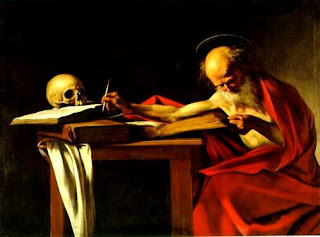
Visibility and Art (Maren)

Monday, January 26, 2009
Valhalla, I Am Coming (Michelle)
Solitude (Michelle)

Deresiewicz summarizes a history of solitude in Western civilization very succinctly and lucidly, from the prophets and saints who drew greatness from solitude to the contemporary 15-minute celebrities. He also, a little predictably but probably correctly, is concerned about the effect of Facebook, text messaging, and---the horror! the horror!---blogs on our ability to be alone. Some highlights:
The great contemporary terror is anonymity. If Lionel Trilling was right, if the property that grounded the self, in Romanticism, was sincerity, and in modernism it was authenticity, then in postmodernism it is visibility.[W]e no longer live in the modernist city, and our great fear is not submersion by the mass but isolation from the herd. Urbanization gave way to suburbanization, and with it the universal threat of loneliness...The child who grew up between the world wars as part of an extended family within a tight-knit urban community became the grandparent of a kid who sat alone in front of a big television, in a big house, on a big lot. We were lost in space.
Losing solitude, what have they lost? First, the propensity for introspection, that examination of the self that the Puritans, and the Romantics, and the modernists (and Socrates, for that matter) placed at the center of spiritual life — of wisdom, of conduct. Thoreau called it fishing "in the Walden Pond of [our] own natures," "bait[ing our] hooks with darkness."
I do think Deresiewicz oversimplifies at times. He seems to labor under the misapprehension that all young people are explicating their inner souls on their MySpace pages, sending 100 text messages a day, and are terrified to be alone. I think the tension between solitude and community, too, is a somewhat eternal one, independent of (post)modernity and the temptations of the internet.
Deresiewicz quotes Emerson at one point, who said: "He who should inspire and lead his race must be defended from traveling with the souls of other men, from living, breathing, reading, and writing in the daily, time-worn yoke of their opinions."
Fair enough, I suppose, but consider what Marley tells Scrooge to remember before it's too late: “It is required of every man...that the spirit within him should walk abroad among his fellow-men, and travel far and wide."
Only you can decide when you are supposed to walk abroad and when you are supposed to go out to Walden and bait your hook with darkness, but at least Deresiewicz raises the question.
Saturday, January 24, 2009
****NEWS FLASH**** (Michelle)
We interrupt our regularly scheduled blah blah blah to tell you that....[drumroll]
Jillian and I are excited to welcome another writer to Daedalus Notes! Coming soon, look for posts from Maren, who is (you guessed it ) another writer. We’re excited to see the different viewpoint she will bring to the blog, and you’ll be excited to see how she will probably not post as often about Doctor Who as Jillian and I do!
A House Divided (Michelle)

It’s not something I’d like to emulate, but I have to confess that I sympathize with him. I want to be one and whole, but as a writer, I feel subject to warring impulses of all kinds. I’ve got enough desires for several lives, not just one. Does anyone else experience this?
I haven’t got them all categorized—and I doubt that anyone would be interested in hearing the definitive catalog anyway—but my crew of Michelles, responsible for getting my life to safe harbor, argue constantly among themselves. There’s Ambitious Michelle, who ferociously wants to get her writing published and be part-of-the-world, constantly at war with Private Michelle, who doesn’t want to make an exhibition of herself and is happiest on some lost floor of a university library. There’s Writer Michelle, who doesn’t understand that Physical Michelle must eat and have health insurance. Don’t even get me started on Domestic Michelle and what that means for Adventurous Michelle. I want to be, well, everything, and I am often extremely discontent that I just can't be.
Contrary to all appearances, I’m not posting this as an opportunity to navel-gaze ad nauseam. (Believe me, I can do that without posting.) It’s just that I think that it might not be just me who can’t reconcile all these impulses. I think a lot of artists experience this. Everybody has contradictions, but artists, who tend to feel and think whatever they feel and think so intensely, practically have multiple selves to deal with.
Even characters can be a bit like multiple selves—I’ve got whole populations and races of people jostling around in my imagination, clamoring to get out! And they all have bits and pieces of me, of course.
I’m not particularly fussed about this. I’d like to think I’m a better captain than Jack Sparrow—nicer to all my little constituents, for a start. I took a walk yesterday, and I didn't kill the Workaholic Michelle who was protesting like mad; I just politely asked the other Michelles to sit on her head.
It also seems to me that it ties in nicely to Plato’s diagnosis of the soul: we have Rational Souls, Appetitive Souls, and Spirited Souls. Happiness is a matter of bringing those souls into balance. I imagine that it’s much the same with the artistic life—none of those Michelles get to run the show, but none of them should be shunted aside either.
F. Scott Fitzgerald is famous for saying that an artist is someone who can hold two opposed views and still function. When I looked it up, it turned out that he actually said, “The test of a first-rate intelligence is the ability to hold two opposed ideas in mind at the same time and still retain the ability to function.” I guess the jury is still out on the subject of my intelligence, and it remains to be seen if I will “retain the ability to function.”
But I’ve got 169 pages of a novel and I love my family: my hopes are high. I hope yours are too.
Wednesday, January 21, 2009
ShakespeaRetold (Michelle)
From dire illness, I return (gradually) to the land of the living and, hence, the blogosphere. And I return with a film recommendation that made me want to write like mad!"My advice to Titania and Oberon? Leave the forest. It's this place. It gets into your head. I mean, all this nature...it's not natural, is it?" (Puck)
"If you don't get it right, I'm going to turn you into a novelty key chain." (Oberon to Puck, of course)

A Misummer Night's Dream, written by Peter Bowker; starring Bill Paterson, Imelda Staunton, and Johnny Vegas
Much Ado About Nothing, written by David Nicholls; starring Sara Parish, Damian Lewis, and Billie Piper
Macbeth, written by Peter Moffat; starring James McAvoy and Keeley Hawes
The Taming of the Shrew, written by Sally Wainwright; starring Rufus Sewell, Shirley Henderson, and Stephen Tompkinson.
Tuesday, January 20, 2009
Doctor Who: the Question of Identity (Jillian)
For those of you who don't know, for months after David Tennant announced he would be leaving the show, a long list of possibilities emerged to replace him as Doctor Eleven. Before Matt Smith was confirmed, there was an interest expressed by several (including Russell T Davies) to have Catherine Zeta-Jones take over the role.
I will be frank. The day the re-creators of Doctor Who decide that he will regenerate into a woman, I will be done with the story. Why? I do not believe this is an issue about feminism or politically correct sentiments. This is a basic tenant of the Doctor's identity. He has been a man for ten regenerations from personality to personality from Time Lord to Time Lord. It is not the same issue as the Doctor asking Rose (right after he regenerated into David Tennant): "Now be honest, how do I look?... Am I ginger?" It is not so simple. In fact, it is complicated... perhaps too complicated. When you change the gender of a character, everything changes. And that is not simple a "rule" that applies to the Doctor and James Bond, but to any character.
I have come to believe that masculinity and femininity are simply not interchangable. And the Doctor so far this revival has not exactly been sexless. Out of the many episodes where the Doctor and Rose struggle with their relationship, or Martha pines away because the Doctor won't even look at her... with a girl in every fireplace... a smarty pants, a lady-killer... the "fire and rage" and the broken soul of a lonely wanderer, a father without children... all these and more point to the reality that the Doctor is undoubtedly a man. In nearly every episode, the inevitable question about the enigma of his identity must be asked: "Who are you?" His answer has been expressed in a variety of ways, but one definitive answer that pops into my head in this moment is from "The Girl in the Fireplace": "I'm the Doctor! And I just snogged Madame de Pompadour!"
The Doctor is an enigma, multiple facets brought out by many different men. The mystery deepens around his name, the lives he's led, the people he's met, the enemies he's battled, the people he's lost. We see him clearer with each mystery. He is many men. And once, you could even say he was a woman - when Donna absorbed his regenerative energy - we did have a taste of this particular what-if. But there can't be more than a question. The Doctor is a fixed point in his story. Perhaps he reflects pieces and echoes of the companions that have shared the TARDIS with him over the years. But he retains a few fixed points of his own. And this has to be one of them.
Welcome
To read more about why Daedalus Notes exists, click here.